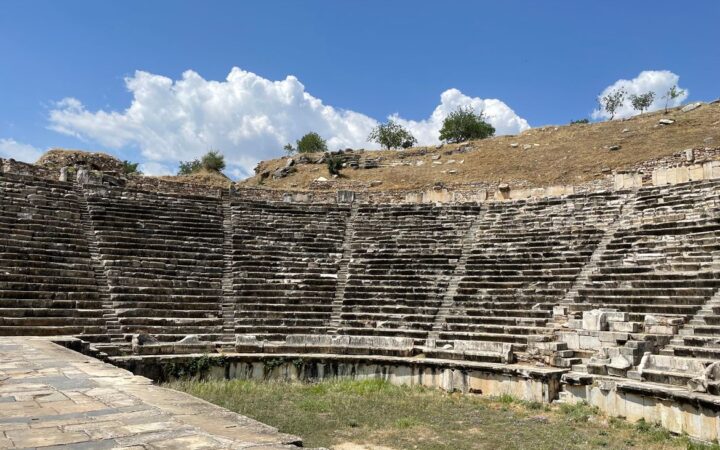
An Italian man has been jailed after constructing a fake Roman amphitheatre near Vicenza, Italy, presenting it as an ancient archaeological discovery and charging tourists as much as €40 to visit.
Franco Malosso, 69, also known in artistic circles as Franz von Rosenfranz, claimed that the site had been uncovered following a landslide in 2005. He promoted the structure as the Berico Maritime Amphitheatre and described it as one of the oldest and largest amphitheatres in the world.
According to his story, the monument dated to AD 393. He also told visitors that Julius Caesar had stopped there after returning from Egypt with Cleopatra and that Juliet Capulet, the fictional character from Shakespeare’s Romeo and Juliet, had lived in a nearby church.
Those claims contained obvious historical contradictions. Julius Caesar died more than four centuries before the date Malosso assigned to the amphitheatre, while Shakespeare’s tragedy is traditionally associated with Verona rather than Vicenza.
Despite the increasingly elaborate narrative, Malosso managed to attract visitors, organize guided tours and historical reenactments, and secure a place for the attraction in an EU-funded tourism guide and mobile application.
Modern Materials Exposed the Ancient Story
Suspicions became more serious in 2016, when the municipality of Arcugnano filed a complaint and Italy’s Carabinieri began investigating the site.
Archaeologists quickly determined that the supposedly ancient complex was modern. The structure contained concrete and rendered blocks, fiberglass, papier-mâché columns, plaster statues and other materials dating from the early 2000s.
Satellite images also showed that the hillside had first been levelled before the theatre was constructed. The approximately 5,000-square-meter complex included tiered seating made from artificially aged stone, cement columns and an artificial pool beneath the arena area.
Cultural heritage authorities found no evidence that a Roman theatre or other ancient structure had previously stood at the location. Specialists also noted that genuine Roman amphitheatres were normally built near established urban settlements, not in isolated countryside without a clear historical context.
Malosso’s explanation reportedly changed as the investigation progressed. He initially presented the site as a genuine archaeological discovery containing remains from multiple periods. Later, he argued that it was merely a reconstruction of a theatre that had once existed beneath the hill.
The Tourist Attraction Ends in Prison
After a legal process lasting approximately a decade, Italy’s Supreme Court confirmed Malosso’s sentence. He was ordered to serve two years and four months in prison for offenses including illegal construction, forgery involving cultural heritage and creating structures without authorization.
He was also fined €3,000. The municipality of Arcugnano has filed a separate damages claim seeking €560,000 to recover losses it says were caused by the deception.
The court ordered the fake theatre and other unauthorized structures to be demolished, with the hillside restored to its original condition. That work had not yet been completed at the time of reporting.
The case has raised questions about how such a large, fabricated attraction could operate for years and enter official tourism materials without proper archaeological verification.
For travelers, it is also a reminder that inclusion in a local guide or booking platform does not necessarily guarantee historical authenticity. Heritage experts argue that archaeological sites should be assessed by qualified specialists before being promoted to visitors.
Italy is filled with genuine Roman monuments, but the Vicenza case proves that even an attraction presented with confident stories, staged events and official-looking promotion can turn out to be little more than modern concrete dressed as ancient history.
Disclaimer: TravelCapybara is an independent media brand owned and operated by NuvexMedia LLC, publishing travel news, destination guides, research, and insights. NuvexMedia LLC may invest in or collaborate with companies across the travel, hospitality, technology, and digital media sectors. These relationships do not influence TravelCapybara’s editorial coverage. While we strive for accuracy, travel requirements, prices, schedules, availability, and local conditions may change without notice. Readers should independently verify information before making travel or purchasing decisions. This content is for informational purposes only and does not constitute professional advice. © 2026 NuvexMedia LLC. All rights reserved.