Sonder was once presented as the company that could combine Airbnb’s flexibility with the quality and consistency of an upscale hotel. Founded in Montreal by Francis Davidson, Lucas Pellan and Martin Picard, the startup expanded rapidly, raised more than $700 million and reached a peak valuation of roughly $2.4 billion.
The idea attracted investors because it appeared to solve one of the biggest weaknesses of short-term rentals. Sonder controlled the guest experience, standardized apartment design and offered professional service instead of relying on individual hosts.
What looked like an advantage, however, became the central weakness of the business. Sonder signed long-term leases, renovated properties and remained responsible for rent even when units were empty. Airbnb could survive a fall in bookings because most accommodation costs remained with hosts. Sonder carried those costs itself.
That exposure became particularly damaging during the pandemic. The company had thousands of apartments and significant fixed commitments just as urban travel disappeared. New investment kept the business alive, but it did not change the economics behind it.
Growth Could Not Overcome the Cost Structure
Sonder continued increasing revenue after travel recovered, generating approximately $465 million in 2022, $602.1 million in 2023 and $621.3 million in 2024. The slowing growth was accompanied by major losses, including about $295.7 million in 2023 and $224.1 million in 2024.
Its 2022 stock market debut through a SPAC transaction also failed to provide a lasting solution. Shares fell sharply as investors moved away from companies that prioritized expansion over profitability.
The partnership with Marriott International offered one final opportunity to stabilize demand. Sonder properties were expected to join Marriott’s booking and loyalty ecosystem under the Sonder by Marriott Bonvoy name. Access to Marriott’s global distribution could have improved occupancy while giving Marriott a fast route into apartment-style urban accommodation.
Instead, the integration created further complications. Marriott ended the licensing agreement in 2025, citing a default by Sonder. The company shut down shortly afterward and entered liquidation.
The collapse demonstrated that strong branding and rising bookings were not enough to support a company carrying expensive leases, renovation costs and operational responsibility across thousands of units.
TravelAI Is Keeping the Brand and Removing the Risk
TravelAI’s acquisition is not an attempt to restart the old Sonder business. The company bought the brand, trademarks and domain portfolio, but none of Sonder’s former properties, leases, employees or accommodation inventory.
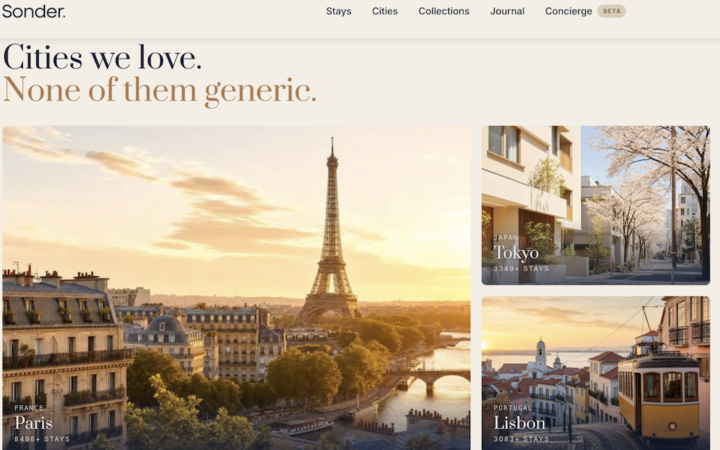
The relaunched Sonder.com is now a curated discovery and booking platform. Its listings come from distribution partners such as Booking.com, Expedia and Vrbo, while TravelAI earns commissions when users complete reservations.
That makes the new model almost the opposite of the original one. TravelAI does not need to renovate apartments, pay landlords or maintain hospitality teams. Its main costs are technology, marketing and customer acquisition.
The attraction is the Sonder name itself. Despite the bankruptcy, travelers continue searching for the brand. TravelAI is betting that this remaining recognition can direct customers toward a marketplace of urban hotels, serviced apartments and professionally managed homes.
The company is also adding AI-based personalization through tools such as Sonder Concierge and Traveler.md. Users can describe a trip, share an existing itinerary and receive accommodation recommendations based on location, design preferences and previous travel behavior.
Our earlier report on the Sonder.com relaunch explains how TravelAI plans to use the brand as a gateway to third-party inventory rather than as a hotel operator.
The strategy could work because TravelAI acquired the strongest remaining asset without inheriting the liabilities that destroyed the original company. A recognizable domain can generate bookings at a much lower cost than building a new consumer brand from zero.
However, the relaunch also carries reputational risk. Some travelers still associate Sonder with cancelled stays and its sudden collapse. TravelAI will need to make the new business model clear while proving that the platform offers more than another layer between travelers and the major booking sites.
Sonder’s first chapter was built around controlling accommodation. Its second is built around controlling discovery. That shift may finally give the brand a business model capable of generating sustainable returns.
Disclaimer: TravelCapybara is an independent media brand owned and operated by NuvexMedia LLC, publishing travel news, destination guides, research, and insights. NuvexMedia LLC may invest in or collaborate with companies across the travel, hospitality, technology, and digital media sectors. These relationships do not influence TravelCapybara’s editorial coverage. While we strive for accuracy, travel requirements, prices, schedules, availability, and local conditions may change without notice. Readers should independently verify information before making travel or purchasing decisions. This content is for informational purposes only and does not constitute professional advice. © 2026 NuvexMedia LLC. All rights reserved.