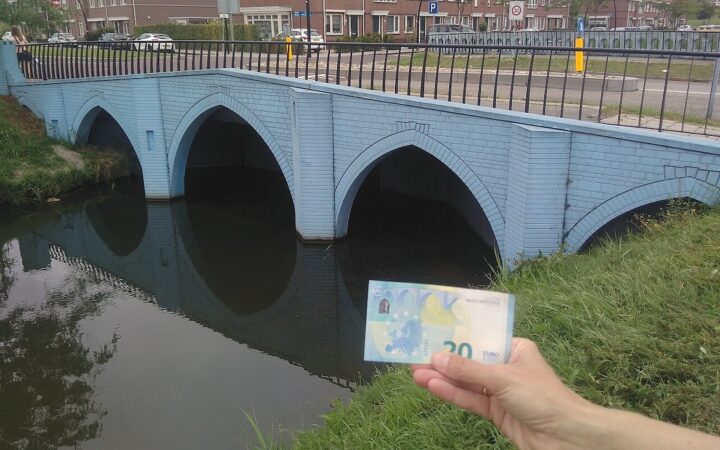
A town in the Netherlands has transformed one of Europe’s most familiar pieces of everyday design into a real-life travel attraction. Spijkenisse, near Rotterdam, is home to seven bridges inspired by the fictional structures printed on the backs of euro banknotes, allowing visitors to see every one of the designs in a single walkable area.
The original euro notes were never meant to show actual landmarks. Each denomination was designed to represent a different period of European architectural history rather than a specific bridge or building. The front of every note features a window or doorway, intended to symbolize openness and cooperation across Europe, while the reverse shows a bridge representing communication between European nations and the wider world.
The €5 note reflects classical architecture, while the €10 design is Romanesque. Other denominations move through Gothic, Renaissance, Baroque and Rococo, 19th-century iron and glass, and modern 20th-century architecture. The designs were deliberately fictional so that no single country would receive special prominence on the shared currency.
Dutch designer Robin Stam changed that in 2011 when he proposed turning the imaginary bridges into physical structures. Working with the local council, he helped incorporate the designs into a new residential development in Spijkenisse. The seven bridges opened gradually between 2011 and 2013.
Rather than recreating large monumental crossings, the project adapted the banknote imagery into smaller pedestrian bridges. Their colors and decorative elements make the connection immediately recognizable, particularly when the structures are compared with the corresponding notes. Together, they form an unusual piece of public art built around a symbol used daily by millions of Europeans.
All seven bridges are located within walking distance of one another, making them easy to visit during a short trip. Spijkenisse can be reached from Rotterdam using metro lines C and D, offering travelers a straightforward day-trip option beyond the city’s better-known architecture and museums.
The bridges have gained renewed attention as discussions continue around future euro banknote designs. A new selection process has prompted debate over what imagery should appear on the next generation of notes, bringing the original architectural series back into public view.
For travelers, the Euro Banknote Bridges offer a quirky reason to visit a place that rarely appears on standard Netherlands itineraries. They also show how something intentionally created without a real-world location can eventually shape one. What began as an effort to keep euro imagery neutral has become a distinctly Dutch attraction, turning fictional architecture into a small but memorable European landmark.