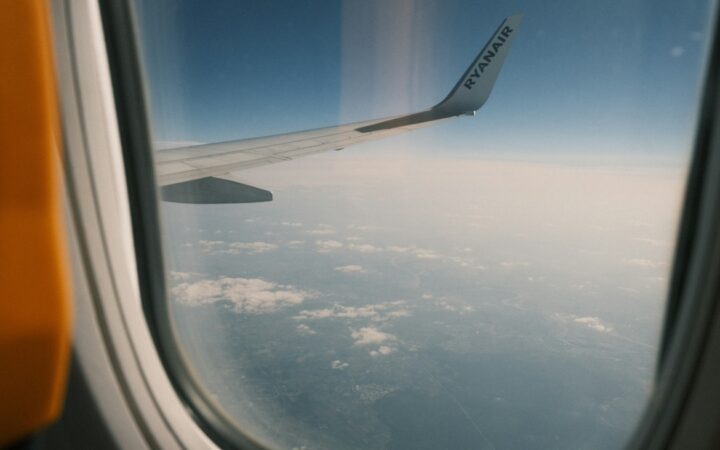
A Ryanair flight from Thessaloniki, Greece, to Memmingen, Germany, made an emergency landing after a passenger window dislodged inflight, injuring a traveler and raising renewed attention around Boeing 737 NG safety. The aircraft returned to Thessaloniki shortly after takeoff on Friday, with passengers later brought back to the terminal.
Ryanair said the flight returned after a passenger window dislodged during the journey and that the aircraft landed normally. One passenger requested and received medical assistance on the ground. The airline arranged a replacement aircraft to take passengers onward to Memmingen later that morning.
The passenger, reported to be a Serbian national, was taken to AHEPA University General Hospital in Thessaloniki. Serbian officials said the injuries were not considered life-threatening, while doctors were still assessing their extent. Local reports described a terrifying scene in which the man was partly pulled toward or through the broken window before other passengers helped bring him back inside.
What Investigators Are Looking At
The aircraft was identified by the U.S. Federal Aviation Administration as a Boeing 737 NG, the generation before the current 737 MAX. Boeing said it was supporting the investigation, which is being led by North Macedonia because the incident occurred over its airspace. The FAA said it was ready to assist.
The exact cause has not been confirmed. However, local Greek reporting and airport sources cited by Reuters pointed to a possible engine-related failure, with debris reportedly striking and breaking the window. Social media video appeared to show engine damage, including missing fan blades, though investigators will need to determine what actually happened.
A possible uncontained engine failure would be especially serious. Such events happen when internal engine parts break and breach the outer casing, sending debris outward. On a passenger jet, flying debris can damage the wing, fuselage, windows or other critical systems.
Flight tracking data showed the aircraft was airborne for just over an hour and reached around 16,000 feet before returning to Thessaloniki. Data also indicated that the same aircraft had diverted back to Thessaloniki the previous evening on a separate flight to Sarajevo, although the reason for that earlier diversion remains unclear.
Why the 2018 Southwest Accident Is Back in Focus
The incident has drawn comparisons to a fatal 2018 accident involving a Southwest Airlines Boeing 737 NG. In that case, a broken engine fan blade caused debris to strike a window, leading to a cabin depressurization and the death of a passenger who was partially pulled from the aircraft.
After that accident, the U.S. National Transportation Safety Board called for changes to the fan cowl structure on Boeing 737 NG aircraft. The FAA later issued a directive requiring Boeing to complete a redesign by July 2028.
There is no confirmed link between the Ryanair incident and the Southwest accident, and investigators have not yet released final findings. Still, the similarities being reported will likely intensify scrutiny of engine containment, inspection history and structural protections around older 737 NG aircraft.
The case also comes after a series of high-profile aviation safety incidents involving Boeing aircraft, including the 2024 Alaska Airlines 737 MAX 9 door plug blowout. Although that was a different aircraft generation and a different type of failure, passenger confidence has become more sensitive to visible cabin and fuselage events.
For travelers, the key point is that emergency procedures worked: the aircraft returned, landed safely and passengers were moved to a replacement flight. For regulators and manufacturers, the bigger question is whether this was an isolated mechanical failure or another warning sign requiring faster action across older aircraft.
Disclaimer: TravelCapybara is an independent media brand owned and operated by NuvexMedia LLC, publishing travel news, destination guides, research, and insights. NuvexMedia LLC may invest in or collaborate with companies across the travel, hospitality, technology, and digital media sectors. These relationships do not influence TravelCapybara’s editorial coverage. While we strive for accuracy, travel requirements, prices, schedules, availability, and local conditions may change without notice. Readers should independently verify information before making travel or purchasing decisions. This content is for informational purposes only and does not constitute professional advice. © 2026 NuvexMedia LLC. All rights reserved.