A major eruption of Indonesia’s Anak Krakatau volcano has triggered widespread travel disruption across the country, forcing airports around Jakarta to close and leaving hundreds of thousands of passengers facing canceled or delayed flights.
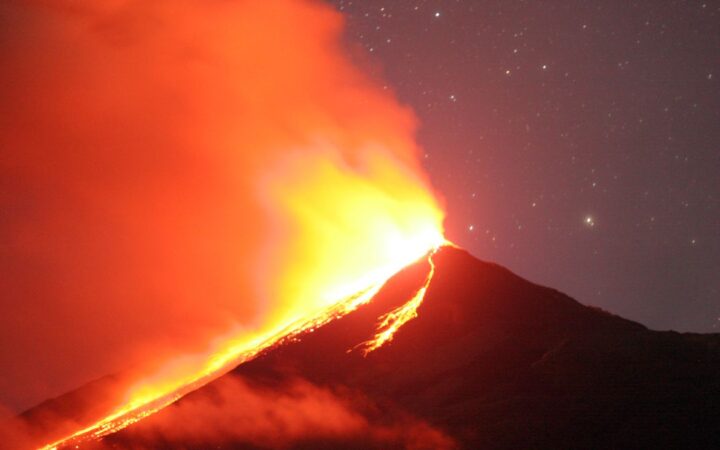
The volcano, located in the Sunda Strait between Java and Sumatra, entered a period of continuous eruption late on September 4. That activity lasted roughly 25 hours before subsiding early Sunday, but additional eruptions followed, including one recorded Sunday evening. Indonesia’s Geological Agency has warned that the probability of further eruptions remains high.
Volcanic ash spread across Jakarta and surrounding regions, creating hazardous conditions for aircraft. Eight airports remained closed early Monday, including Jakarta’s main Soekarno-Hatta International Airport and airports serving nearby parts of West Java and Lampung.
Passenger impact estimates increased as the disruption continued. Indonesian authorities said around 170,000 travelers had been affected by cancellations, while later reporting indicated as many as 270,000 passengers had been stranded and more than 2,000 flights grounded across the country.
Jakarta Flights Face Major Disruption
Soekarno-Hatta, one of Southeast Asia’s busiest airports, repeatedly extended its closure as authorities monitored ash conditions. The airport handles millions of seats each month and serves as Indonesia’s principal international aviation gateway, meaning disruption there quickly spread through domestic and regional airline networks.
Singapore Airlines canceled multiple services between Singapore and Jakarta, while Scoot also suspended flights on the route. Travelers at Indonesian airports reported crowded terminals, repeated schedule changes and difficulty finding replacement flights.
Some passengers turned to trains and other ground transportation. Others faced waits of several days for alternative international departures as airlines worked through the backlog.
Indonesia’s meteorological agency detected volcanic ash at altitudes reaching approximately 20,000 feet east of the volcano and as high as 50,000 feet to the west. Ash was observed over Jakarta, Banten and surrounding areas and extended toward the Indian Ocean.
Volcanic ash presents a serious aviation hazard because particles can damage aircraft engines and other systems, making closures necessary even when an airport itself is not directly threatened by lava or other volcanic activity.
Further Eruptions Remain Possible
Anak Krakatau remains at Level III, or Alert status. Authorities are maintaining a three-kilometer exclusion zone around the crater, with ships also prohibited from entering the restricted area.
Residents have been advised to wear masks outdoors because of ashfall, while schools in Jakarta and Lampung have moved some classes online to reduce health risks.
Officials said airport conditions were being tested repeatedly as weather can rapidly change the direction and concentration of volcanic ash. Transport Minister Dudy Purwagandhi warned that authorities could not predict exactly when the disruption would end because both volcanic activity and atmospheric conditions remain dynamic.
Anak Krakatau, meaning “Child of Krakatau,” emerged during the 20th century from the volcanic system left by the catastrophic 1883 Krakatau eruption. It remains one of Indonesia’s most closely watched volcanoes.
For travelers, the immediate priority is monitoring airline updates before heading to airports around Jakarta and western Indonesia. Even after airports reopen, cancellations, aircraft displacement and passenger backlogs could continue affecting schedules while airlines rebuild normal operations.
Disclaimer: TravelCapybara is an independent media brand owned and operated by NuvexMedia LLC, publishing travel news, destination guides, research, and insights. NuvexMedia LLC may invest in or collaborate with companies across the travel, hospitality, technology, and digital media sectors. These relationships do not influence TravelCapybara’s editorial coverage. While we strive for accuracy, travel requirements, prices, schedules, availability, and local conditions may change without notice. Readers should independently verify information before making travel or purchasing decisions. This content is for informational purposes only and does not constitute professional advice. © 2026 NuvexMedia LLC. All rights reserved.