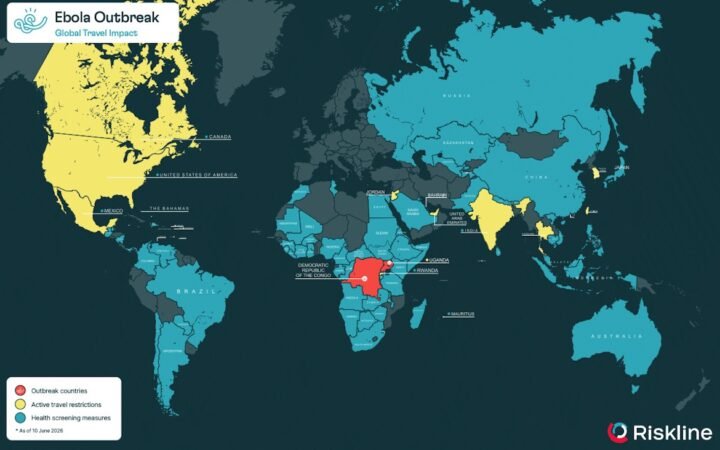
Riskline has launched a new Ebola outbreak surveillance map to help travelers, companies and travel managers monitor restrictions linked to the latest Ebola outbreak in Central and East Africa. The tool consolidates outbreak developments, entry bans, quarantine rules and health screening measures into one view, giving planners a clearer picture of how a regional health emergency can affect global travel.
As of June 15, the Democratic Republic of the Congo and Uganda are the only countries affected by confirmed Ebola cases and transmission. Yet the travel impact has already spread much further. Riskline says 22 countries and territories have introduced stricter travel measures in response to the outbreak, including entry bans, quarantine requirements, visa issuance suspensions, border closures and wider transport disruptions.
The list of countries with stricter measures includes destinations across Africa, the Middle East, Asia, the Americas and the Caribbean. The United States, Canada, India, Mexico, South Korea, Thailand, the United Arab Emirates and The Bahamas are among those that have imposed some form of restriction or enhanced control. For travelers, this means that even a trip not ending in an outbreak area may be affected if it includes recent travel history, transit through certain airports or connections involving restricted routes.
Health screening is even more widespread. Riskline says 93 countries and territories have implemented Ebola-related screening measures, which commonly include temperature checks, health declaration forms and questions about recent travel. These checks may not prevent travel outright, but they can create delays, missed connections and secondary holds, particularly for travelers moving through busy international airports.
For corporate travel teams, the outbreak is a reminder that medical risk and border policy are now deeply connected. A traveler based in the DRC, Uganda or a neighboring country may face restrictions not only at the destination, but also when returning home. Travel managers may need to review active itineraries, identify alternate routes, check quarantine rules and brief employees before departure.
The situation is especially complex because the outbreak involves the Bundibugyo strain of Ebola, for which there is currently no approved vaccine. Riskline notes that personal protective measures remain central for travelers in affected regions, including careful hygiene, avoiding contact with symptomatic individuals and avoiding contact with remains, bushmeat or live animals.
The current outbreak is also part of a recurring pattern. The DRC has experienced multiple Ebola outbreaks, and travel managers with long-term operations in Central and East Africa may need standing procedures rather than one-off responses. That includes pre-approved rerouting options, quarantine planning, medical evacuation review and reliable intelligence on restriction changes.
For leisure travelers, the main lesson is not to panic, but to plan carefully. Ebola does not spread like airborne respiratory viruses, but government restrictions can still change quickly. Travelers with recent exposure to affected regions should check current entry rules before booking, leave more time for screening and avoid assuming that a route is clear simply because the destination itself has no cases.
Disclaimer: TravelCapybara is an independent media brand owned and operated by NuvexMedia LLC, publishing travel news, destination guides, research, and insights. NuvexMedia LLC may invest in or collaborate with companies across the travel, hospitality, technology, and digital media sectors. These relationships do not influence TravelCapybara’s editorial coverage. While we strive for accuracy, travel requirements, prices, schedules, availability, and local conditions may change without notice. Readers should independently verify information before making travel or purchasing decisions. This content is for informational purposes only and does not constitute professional advice. © 2026 NuvexMedia LLC. All rights reserved.