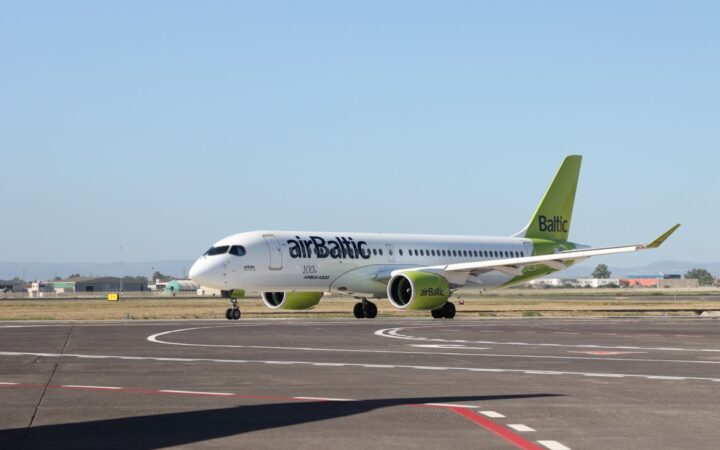
airBaltic is abandoning one of Europe’s most ambitious airline expansion plans and preparing to shrink dramatically as the Latvian carrier puts financial survival ahead of growth.
Under a new business plan approved in August, airBaltic expects to reduce its all-Airbus A220-300 fleet from 54 aircraft to about 36 by the end of 2026. The fleet would then grow only gradually to around 40 aircraft by 2031.
That is a major reversal from the airline’s previous strategy, which envisioned a fleet of approximately 100 aircraft as part of preparations for a planned initial public offering.
Management says the assumptions behind that expansion have changed. Passenger demand and revenue growth have moderated, while the wars in Ukraine and the Middle East have increased uncertainty and operating costs. Long-running Pratt & Whitney engine availability problems have also prevented airBaltic from using its entire A220 fleet efficiently.
Riga Will Become the Clear Center of airBaltic
The smaller airline will focus more heavily on Riga, which will remain its principal hub. Instead of continuously adding new destinations across the Baltic region, airBaltic plans to concentrate aircraft on established markets where demand and profitability are strongest.
Secondary bases in Tallinn, Vilnius and Tampere will remain, but their role is expected to become more selective, with carefully chosen point-to-point routes and seasonal flying.
The contraction will be visible in capacity. Scheduled available seat kilometers are projected to fall from about 9.6 billion in 2026 to 8.7 billion in 2027, a decline of roughly 9.4%, before recovering gradually to 10.5 billion by 2031.
airBaltic also intends to expand ACMI operations, where it provides aircraft, crews, maintenance and insurance to other airlines. The strategy should help reduce the financial impact of weak Baltic winter demand by placing aircraft with partners throughout the year.
The airline already operates substantial capacity for Lufthansa Group, which owns 10% of airBaltic. The Latvian government remains the dominant shareholder with roughly 88%.
The Bigger Challenge Is Finding €225 Million
Fleet cuts alone will not solve airBaltic’s immediate financial problem. The airline is seeking €225 million in interim financing to cover near-term liquidity needs while preparing a broader recapitalization.
That funding has not yet been secured.
The longer-term plan could include another €225 million of new debt and €100 million in new equity. Part of airBaltic’s existing 2029 secured bonds would be converted into shares, while remaining debt could be replaced with up to €125 million of reduced borrowing.
Bondholder approval is therefore critical, with a reconvened vote scheduled for August 17.
The new plan follows warnings about airBaltic’s liquidity and comes after Latvia provided a €30 million short-term loan earlier this year.
Management expects the restructuring to generate about €45 million in recurring annual benefits through lower costs and improved efficiency. Revenue is forecast to fall to around €800 million in 2027 before eventually reaching €1 billion in 2031.
For passengers, the immediate message is less dramatic: airBaltic says its current flight schedule, existing bookings and services are continuing normally.
But strategically, the airline is becoming something very different. The carrier that once planned a 100-aircraft fleet is now preparing for 40, with Riga at its center and financial stability replacing rapid expansion as the overriding priority.
Disclaimer: TravelCapybara is an independent media brand owned and operated by NuvexMedia LLC, publishing travel news, destination guides, research, and insights. NuvexMedia LLC may invest in or collaborate with companies across the travel, hospitality, technology, and digital media sectors. These relationships do not influence TravelCapybara’s editorial coverage. While we strive for accuracy, travel requirements, prices, schedules, availability, and local conditions may change without notice. Readers should independently verify information before making travel or purchasing decisions. This content is for informational purposes only and does not constitute professional advice. © 2026 NuvexMedia LLC. All rights reserved.