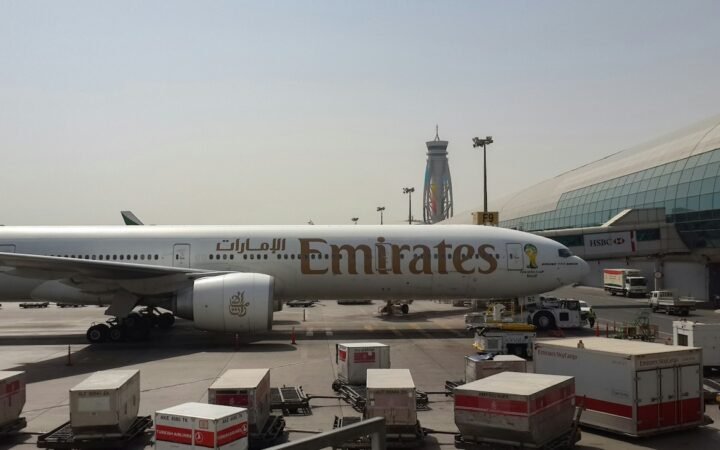
Dubai International has been named the world’s busiest international airport for the 12th consecutive year, extending one of the strongest records in global aviation. Dubai Airports said DXB retained the title in 2026 after welcoming 95.2 million guests in 2025 and connecting travelers to more than 260 destinations across six continents.
The ranking reinforces Dubai’s position as one of the world’s most important air transport hubs, serving not only as a transfer point between Europe, Asia, Africa and the Middle East, but also as a destination for business, tourism and long-term residence. The airport’s scale remains central to Dubai’s broader economy, linking aviation with hospitality, trade, retail, logistics and events.
The recognition comes after a difficult period for regional aviation. Airspace disruption that began on February 28 and intensified through March placed pressure on flight schedules and routing capacity across a critical corridor. Dubai’s airports remained operational through the disruption, supporting the movement of 6 million guests, more than 32,000 aircraft movements and 213,000 tonnes of essential cargo by April 30.
The impact was visible in first-quarter numbers. DXB handled 18.6 million guests in Q1 2026, down 20.6% year on year. March was especially affected, with passenger traffic falling to 2.5 million, a 65.7% decline from the same month last year. Aircraft movements also fell 20.8% to 88,000 during the quarter, while cargo volumes dropped 22.7% to 399,600 tonnes.
Even with those declines, DXB’s underlying market strength remained clear. India was again the airport’s largest country market, with 2.5 million guests in the first quarter, followed by Saudi Arabia with 1.3 million, the United Kingdom with 1.2 million and Pakistan with 918,000. London remained the busiest city destination, with 752,000 guests, followed by Mumbai and Jeddah.
Operational performance also remained an important part of the airport’s message. DXB processed 17.6 million bags during the quarter, including 2.6 million in March. Its mishandled baggage rate rose to 3.5 bags per 1,000 passengers, but still remained below the latest global benchmark of around 6.3 mishandled bags per 1,000 passengers.
Looking ahead, Dubai Airports expects demand to remain strong as regional airspace capacity improves. With UAE airspace now fully restored, DXB is increasing flight movements and working with airline and airspace partners to unlock additional network capacity. At the same time, long-term expansion at Dubai World Central – Al Maktoum International continues to progress, giving Dubai another platform for future aviation growth.
For travelers and airlines, DXB’s latest ranking shows that Dubai’s airport system remains one of the most resilient and strategically important in the world. The challenge now is to convert restored airspace access into sustained traffic recovery through the rest of 2026.
Disclaimer: TravelCapybara is an independent media brand owned and operated by NuvexMedia LLC, publishing travel news, destination guides, research, and insights. NuvexMedia LLC may invest in or collaborate with companies across the travel, hospitality, technology, and digital media sectors. These relationships do not influence TravelCapybara’s editorial coverage. While we strive for accuracy, travel requirements, prices, schedules, availability, and local conditions may change without notice. Readers should independently verify information before making travel or purchasing decisions. This content is for informational purposes only and does not constitute professional advice. © 2026 NuvexMedia LLC. All rights reserved.