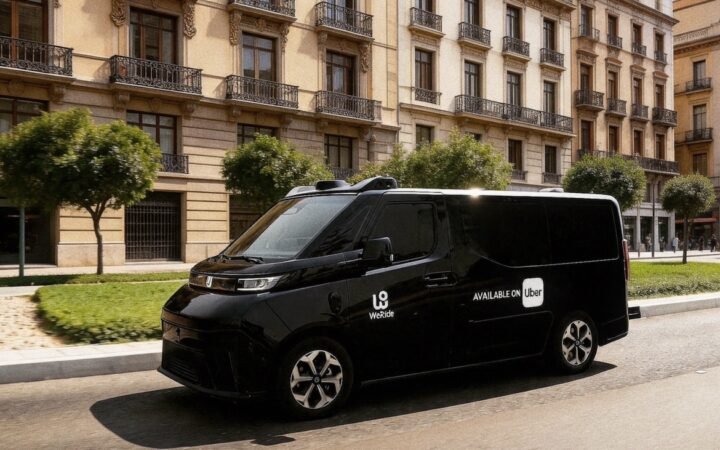
Uber and WeRide are preparing to bring robotaxi rides to Madrid later this year, marking their first joint entry into Europe and Spain’s first planned commercial autonomous vehicle pilot. The service is expected to launch in collaboration with the Madrid Regional Government, with passengers able to request rides through the Uber app.
The rollout will begin with trained vehicle operators on board, a cautious first step before any wider move toward fully driverless service. WeRide, Uber and AVOMO, a Moove Cars Group company, say the fleet will scale gradually as performance milestones are met. Their longer-term plan includes adding hundreds of robotaxis and expanding fully driverless commercial service across core urban areas.
For travelers, the pilot could become an early glimpse of how airport transfers, hotel connections, nightlife trips and short urban rides may evolve in major European cities. Madrid already has strong demand for taxis, ride-hailing and public transport, especially around business districts, cultural neighborhoods, rail hubs and tourism zones. A robotaxi option inside the Uber app would place autonomous mobility directly into a platform many visitors already use.
Madrid Becomes a European Test Market
The companies describe Madrid as one of Europe’s most attractive robotaxi markets because of its large urban population, high mobility demand and supportive policy environment. That combination matters because autonomous ride services require more than vehicle technology. They also need road testing, local regulation, operational partners, mapping, fleet maintenance and public trust.
AVOMO will support the transport service in Madrid, bringing operational experience from autonomous vehicle fleet work in the United States. The company already works with Uber in Atlanta and Austin and manages hundreds of autonomous vehicles with a specialist team. In Madrid, that operating role could be important as the pilot moves from announcement to real public service.
WeRide will provide the autonomous driving technology, supported by its WeRide One platform and WeRide GENESIS simulation platform. The company says it has deployed autonomous vehicles in more than 40 cities across 12 countries and holds autonomous driving permits in several markets, including China, the UAE, Singapore, France, Switzerland, Saudi Arabia, Belgium and the United States.
Robotaxis Move From Novelty to Travel Infrastructure
The Madrid plan builds on WeRide and Uber’s experience in the Middle East, where robotaxi services are already operating in Abu Dhabi and Dubai, with Riyadh expected to follow. That track record is central to the companies’ European argument: they want to show that autonomous mobility can move beyond limited demonstrations and become a repeatable city service.
Madrid is also part of a broader WeRide-Uber agreement covering 15 cities, with 11 more expected by 2030. Under that partnership, the companies aim to deploy tens of thousands of robotaxis on public roads worldwide. If that target is met, autonomous ride-hailing could become a visible part of urban travel in multiple regions.
The travel implications are significant but still early. Robotaxis could offer tourists a familiar app-based way to move around an unfamiliar city, while giving local transport systems another option for short-distance trips. At the same time, public acceptance will depend on safety, reliability, pricing, availability and how well the vehicles interact with Madrid’s dense traffic, pedestrians, buses, scooters and taxis.
For Uber, the project extends its role from ride-hailing platform to autonomous mobility distributor. For WeRide, Madrid is a chance to prove its technology in a complex European capital. For travelers, it may soon mean that a ride across Madrid could arrive without a traditional driver, but still through the same app they already know.
Disclaimer: TravelCapybara is an independent media brand owned and operated by NuvexMedia LLC, publishing travel news, destination guides, research, and insights. NuvexMedia LLC may invest in or collaborate with companies across the travel, hospitality, technology, and digital media sectors. These relationships do not influence TravelCapybara’s editorial coverage. While we strive for accuracy, travel requirements, prices, schedules, availability, and local conditions may change without notice. Readers should independently verify information before making travel or purchasing decisions. This content is for informational purposes only and does not constitute professional advice. © 2026 NuvexMedia LLC. All rights reserved.