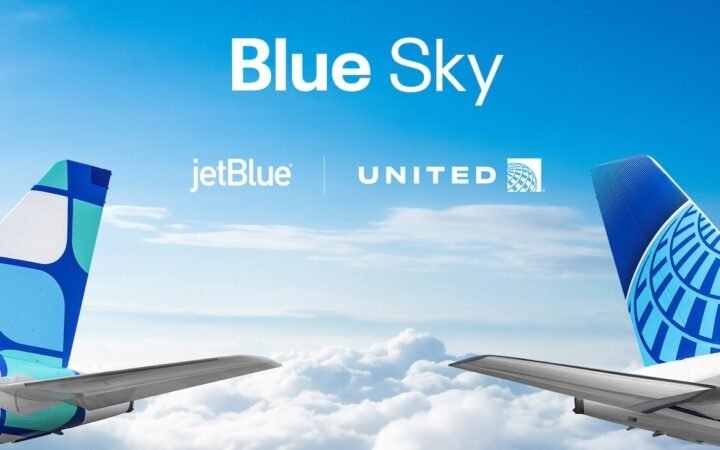
JetBlue and United Airlines are deepening their Blue Sky partnership with reciprocal loyalty benefits, giving eligible TrueBlue and MileagePlus members access to a wider set of perks when flying across either airline’s network. The update marks the latest phase of a collaboration designed to make the two carriers more connected without creating a traditional merger or joint venture.
Beginning this week, eligible members who add their frequent flier number to a booking can receive benefits that include priority boarding, complimentary access to extra legroom seating at check-in, preferred seat selection after booking, one free checked bag, priority bag handling, priority check-in and security, and same-day standby options. The benefits apply across both airline networks, subject to program rules and availability.
The boarding benefits are tiered by status level. United MileagePlus Premier Platinum and Premier 1K members will board with Group 1 on JetBlue flights, Premier Gold members with Group 2 and Premier Silver members with Group 3. On United flights, JetBlue Mosaic 2, 3 and 4 members will board with Group 1, while Mosaic 1 members will board with Group 2.
For customers, the immediate value is practical. A JetBlue elite member flying United can now receive benefits that feel closer to the experience they expect on their home airline, while a United elite member flying JetBlue can receive similar recognition. That reduces one of the biggest frictions in interline travel: losing status value when a trip requires another carrier.
Blue Sky Moves From Booking Access to Status Recognition
The loyalty expansion is the third major step in the Blue Sky partnership. The airlines previously launched point earning and redemption across eligible itineraries, then added cross-booking capabilities that allow travelers to buy United tickets through JetBlue channels and JetBlue tickets through United channels.
The next major piece still to come is single-itinerary ticketing for connecting travel involving both airlines. Once enabled, that could make the partnership more useful for travelers building trips that combine JetBlue’s strength in leisure markets with United’s broader domestic and international network, including United Express.
The strategy also reflects how airlines are using partnerships to broaden customer reach without the complexity of full consolidation. JetBlue gains access to a larger network footprint, while United strengthens its ability to serve customers in markets where JetBlue has strong relevance, particularly in leisure-heavy routes.
The partnership also has a New York angle. In 2027, JetBlue is expected to lease up to seven daily takeoff and landing slots to United at JFK Airport, which could allow United to restart operations there. That would be a notable move in one of the most competitive and slot-constrained airport markets in the United States.
For frequent flyers, the bigger message is that loyalty is becoming more portable, but also more strategic. Airlines increasingly know that customers value status recognition, seat comfort, baggage benefits and smoother airport handling as much as points. Blue Sky gives JetBlue and United a way to extend those benefits across a broader travel map.
The arrangement still depends on execution. Travelers will want clear rules, reliable recognition and fewer surprises when booking or checking in. But if the partnership works as intended, it could make both loyalty programs feel more valuable and give passengers more flexibility without forcing them to abandon their preferred airline.
Disclaimer: TravelCapybara is an independent media brand owned and operated by NuvexMedia LLC, publishing travel news, destination guides, research, and insights. NuvexMedia LLC may invest in or collaborate with companies across the travel, hospitality, technology, and digital media sectors. These relationships do not influence TravelCapybara’s editorial coverage. While we strive for accuracy, travel requirements, prices, schedules, availability, and local conditions may change without notice. Readers should independently verify information before making travel or purchasing decisions. This content is for informational purposes only and does not constitute professional advice. © 2026 NuvexMedia LLC. All rights reserved.