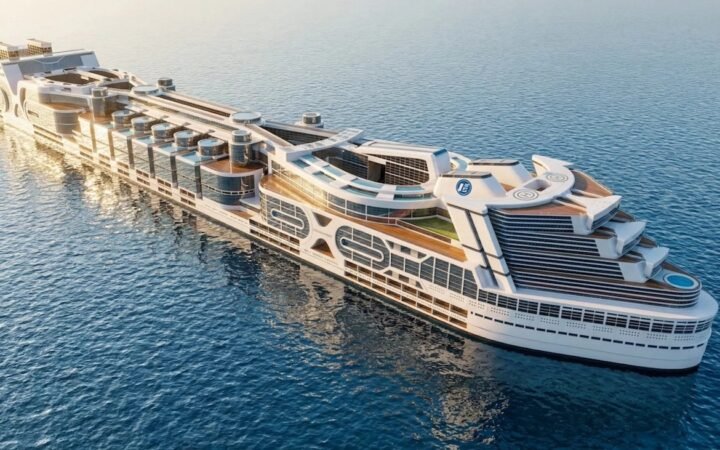
Freedom Cruise Line is reviving one of the most ambitious concepts in marine travel: a nuclear-powered floating city with capacity for up to 80,000 people. The proposed Freedom Ship would be far larger than any existing cruise ship, with plans for permanent residents, short-term tourists, a large workforce and the infrastructure of a functioning city at sea.
The project is expected to cost about $16.16 billion and would take roughly four years to build, according to the company’s current plans. If completed, the vessel would include homes for about 50,000 residents, rooms for 10,000 tourists and operations managed by around 20,000 employees. Its scale would dwarf today’s largest cruise ships, including Royal Caribbean’s Icon of the Seas, which can carry about 7,600 passengers and 2,350 crew members.
Freedom Cruise Line describes the ship not as a traditional cruise vessel but as a permanently mobile city. Instead of operating fixed itineraries or seasonal routes, it would remain mostly in international waters and slowly circle the globe every two to three years. Because of its size, it would be unable to dock at conventional ports, so passengers and residents would rely on ferries and helicopters to travel between the ship and land.
The proposed design includes many elements of an urban environment. Plans call for schools, hospitals, banks, shops, clubs, gyms, movie theaters, two museums, a music hall, a convention center, malls, a two-story food hall, an aquarium, a water park and a 15,000-seat sports stadium. A tram system would connect different areas of the mile-long structure, while the top deck would include a large helipad capable of accommodating eight helicopters.
The company also says it wants the vessel to feel less like a novelty attraction and more like a livable community. Green spaces, walkways and softened architectural edges are part of the design concept, with an emphasis on making daily life feel familiar despite the unusual setting. Supporters of the project frame it as a residential city that happens to move, rather than a floating resort built around short-term entertainment.
The Freedom Ship idea is not new. Versions of the concept date back to the 1990s, when engineer Norman Nixon promoted plans for a massive residential vessel that would travel continuously around the world. Nixon died in 2012 without bringing the idea to reality, and the project remained largely dormant for years.
The latest version faces the same central challenge: financing. Freedom Cruise Line CEO Roger Gooch has said the company is confident the project can be assembled, but capitalization remains essential. That is a major hurdle for a concept that combines cruise operations, residential real estate, port logistics, nuclear power, maritime regulation and city-scale infrastructure.
If built, the Freedom Ship would blur several categories at once. It would not be a cruise ship in the usual sense, nor a conventional city, nor simply a luxury residence at sea. It would represent a new experiment in mobility, private infrastructure and long-term marine living. For now, however, it remains a proposal whose ambition is matched by the complexity of making it real.
Disclaimer: TravelCapybara is an independent media brand owned and operated by NuvexMedia LLC, publishing travel news, destination guides, research, and insights. NuvexMedia LLC may invest in or collaborate with companies across the travel, hospitality, technology, and digital media sectors. These relationships do not influence TravelCapybara’s editorial coverage. While we strive for accuracy, travel requirements, prices, schedules, availability, and local conditions may change without notice. Readers should independently verify information before making travel or purchasing decisions. This content is for informational purposes only and does not constitute professional advice. © 2026 NuvexMedia LLC. All rights reserved.