Emirates has completed the first retrofit of one of its two-class Airbus A380 aircraft, marking another major step in the airline’s multibillion-dollar cabin renewal program. The refurbished aircraft, registered A6-EUX, has returned to service on the Dubai-Birmingham route as flight EK 39/40, now featuring three cabin classes instead of two.
The aircraft has been reconfigured with 76 Business Class seats, 56 Premium Economy seats and 437 Economy Class seats. It is the first of 15 two-class A380s that Emirates plans to renovate, as the airline continues working toward a more consistent onboard product across its widebody fleet.
The retrofit was carried out entirely in-house by Emirates Engineering in Dubai. So far, the wider program has completed work on 95 Emirates aircraft, including 42 Airbus A380s and 53 Boeing 777s. That represents more than one third of the airline’s current fleet and shows the scale of a project that has become central to Emirates’ long-term passenger experience strategy.
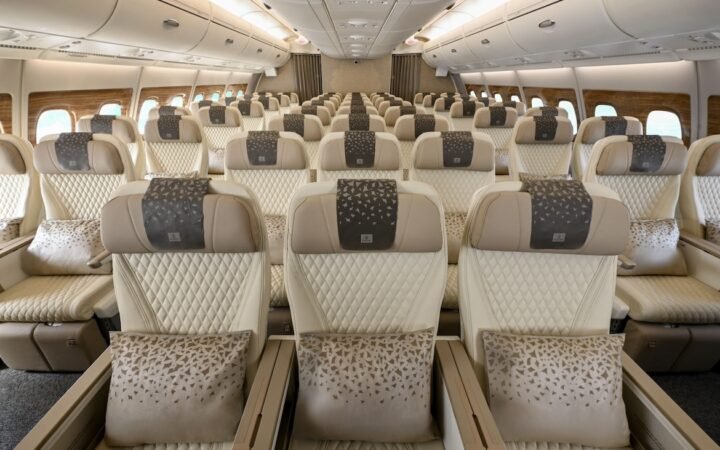
The most notable change is the arrival of Premium Economy on the upper deck of a two-class A380 for the first time. The cabin is configured 2-3-2 and includes leather seats with generous recline, full leg and footrests, adjustable headrests, built-in charging ports, side cocktail tables and 13.3-inch personal entertainment screens. The move gives Emirates another way to serve travelers looking for more comfort than Economy without stepping up to Business Class.
The aircraft also received refreshed interiors across all cabins, including latest-generation seats, new carpets, ceiling panels, updated cabin finishes, modern color palettes, Ghaf tree motifs and premium wood-style elements. The goal is to make the refurbished aircraft feel aligned with Emirates’ newer onboard design language rather than simply adding one extra cabin.
The engineering work was extensive. Emirates removed 120 Economy Class seats from the upper deck to make space for Premium Economy and additional Business Class capacity. Teams also had to reposition or upgrade galleys, stowage areas, overhead bins, partitions, electrical systems and plumbing. Around 50 engineers and technicians worked on the project, investing roughly 35,000 man-hours and using more than 2,500 types of parts.
The first retrofit took about two months, including planning and testing, but Emirates expects future two-class A380 retrofits to take around 30 days as processes improve. The airline aims to complete all 15 two-class A380 retrofits by the end of 2026.
The broader retrofit program has expanded significantly since it was first announced in 2021. Initially covering 120 aircraft, it was later increased to 191 and then to 219 aircraft after positive customer response. Emirates says a dedicated team of around 270 staff now supports the program, with an average of two refreshed aircraft leaving its Dubai engineering hangars each month.
The program also includes an upcycling component. Materials removed from aircraft interiors are being evaluated for reuse, including in Emirates’ Aircrafted luggage pieces and backpacks made from repurposed Economy Class seat fabric. For Emirates, the A380 retrofit is not just a cabin upgrade. It is a long-term bet that product consistency, Premium Economy demand and refreshed onboard design will remain critical to competing on long-haul routes.
Disclaimer: TravelCapybara is an independent media brand owned and operated by NuvexMedia LLC, publishing travel news, destination guides, research, and insights. NuvexMedia LLC may invest in or collaborate with companies across the travel, hospitality, technology, and digital media sectors. These relationships do not influence TravelCapybara’s editorial coverage. While we strive for accuracy, travel requirements, prices, schedules, availability, and local conditions may change without notice. Readers should independently verify information before making travel or purchasing decisions. This content is for informational purposes only and does not constitute professional advice. © 2026 NuvexMedia LLC. All rights reserved.