Emirates is once again trying to raise the ceiling on luxury air travel, with airline president Tim Clark revealing that the carrier is working on private en-suite bathrooms inside first-class suites.
Even by the standards of premium aviation, the idea is striking. Emirates already helped redefine first class with fully enclosed suites and onboard shower spas on the Airbus A380. Now it is signaling that the next stage of the contest may be even more exclusive, more private, and more theatrical.
The announcement matters because first class is no longer just about seat comfort or fine dining. For the world’s biggest premium brands, it has become a statement product, one that influences reputation far beyond the few passengers who actually buy it. In that sense, Emirates is not simply designing a better cabin. It is reinforcing its image as one of the airlines most willing to invest in aviation as spectacle.
From Shared Shower Spas to Private En-Suites
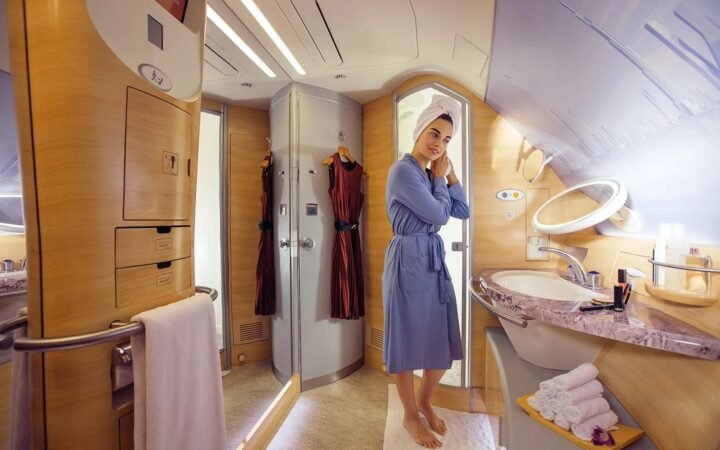
Today, Emirates offers two different versions of first class across its long-haul fleet. On the Airbus A380, first-class passengers already have access to the airline’s signature shared shower spas, which were introduced in 2008 and remain one of the most recognizable luxury features in commercial aviation. On the Boeing 777, the carrier offers fully enclosed floor-to-ceiling suites, but no shower facilities.
That makes the idea of private en-suite bathrooms especially significant. If Emirates can make the concept work, it would move from offering a premium shared bathroom experience to giving individual first-class passengers something closer to a private hotel room in the sky. Clark’s comments also suggest this is part of a broader philosophy inside the airline: keep refining the top-end product so it never feels static or dated.
The practical challenges, of course, are enormous. Private bathrooms inside individual suites would take up valuable cabin space, likely reducing the number of first-class seats an aircraft can carry. They would also create new engineering, certification, and weight-management problems, especially on aircraft where first class is already a tightly planned real-estate equation. In aviation, every square foot matters, and luxury innovations only survive if airlines believe the branding and revenue gains justify the complexity.
Why the First-Class Arms Race Is Back
Emirates is not acting in isolation. The move reflects a broader return of airline interest in first class, even after years in which many carriers focused more heavily on business class. Competitors and manufacturers are once again exploring products aimed at the very top of the market, where privacy, exclusivity, and novelty matter as much as the traditional elements of service.
Part of the reason is simple: first class works as a brand weapon. Even if only a small number of passengers ever experience it, the product influences how the airline is perceived across all cabins. Emirates has long understood that dynamic. A bold first-class product helps distinguish the brand in a crowded global market and supports its broader premium positioning.
For travelers, the private bathroom concept is still only a vision, not a launch plan. No timeline has been announced, and Emirates has not shared design specifics. But even at this stage, the message is unmistakable. In the race to reinvent first class, Emirates wants to stay ahead, and it is willing to push airline luxury into territory that once sounded closer to fantasy than commercial aviation.
Disclaimer: TravelCapybara is an independent media brand owned and operated by NuvexMedia LLC, publishing travel news, destination guides, research, and insights. NuvexMedia LLC may invest in or collaborate with companies across the travel, hospitality, technology, and digital media sectors. These relationships do not influence TravelCapybara’s editorial coverage. While we strive for accuracy, travel requirements, prices, schedules, availability, and local conditions may change without notice. Readers should independently verify information before making travel or purchasing decisions. This content is for informational purposes only and does not constitute professional advice. © 2026 NuvexMedia LLC. All rights reserved.