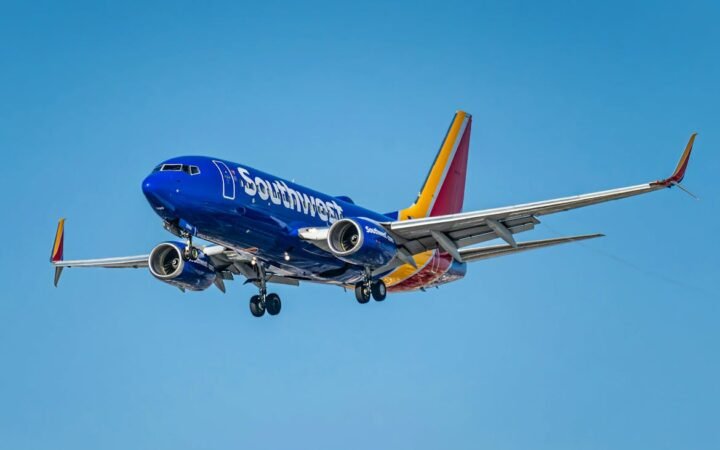
Southwest Airlines says the first quarter of 2026 marked a turning point, with management arguing that the carrier’s controversial commercial overhaul is now producing real financial gains. The airline reported operating income of $330 million, reversing an operating loss of $223 million a year earlier, while net income came in at $227 million. Operating revenue reached a record $7.25 billion for the quarter, up 12.8% year over year, and the airline’s operating margin improved by 8.1 percentage points to 4.6%.
Those numbers are significant because they arrive after one of the biggest strategic shifts in Southwest’s history. Long known for its simpler product and resistance to the unbundling model embraced by rivals, the carrier has spent the past 18 months introducing assigned seating, extra-legroom seats, bag fees, and a more stripped-down base fare. Management is now presenting the results as proof that customers were willing to accept those changes and, in many cases, pay more for them.
New Fees and Seating Changes Lift Revenue
The strongest evidence for Southwest’s argument came from customer behavior. The airline said about 60% of customers are now buying up from the base fare, compared with roughly 20% last year. Yield rose 11.5%, while unit revenue also climbed sharply, showing that Southwest is generating more revenue per passenger mile even before any major international expansion or premium-cabin rollout.
Corporate demand was another bright spot. Managed corporate revenue rose 16% in the first quarter and 25% in March, both record increases for the airline. Executives said the January launch of assigned seating and a new boarding process helped attract new corporate customers while also encouraging existing business travelers to buy up where company policy allowed. That matters because Southwest has long wanted a stronger presence among managed business accounts, and this suggests its product changes are helping remove one of the biggest barriers for corporate buyers.
The company is also leaning into further upgrades. It said Starlink Wi-Fi is scheduled to begin entering service this summer, while in-seat power and larger overhead bins are being installed across more of the fleet. Together, those changes point to a carrier trying to modernize its value proposition without abandoning its short-haul domestic strength.
Fuel Costs Still Cloud the Outlook
The biggest challenge remains fuel. Southwest’s first-quarter fuel cost came in at $2.73 per gallon, above prior guidance and enough to create a $164 million headwind in the quarter. Management warned that second-quarter fuel costs could rise to more than $4.10 per gallon, creating a potential $1 billion fuel headwind. That is a major risk for an airline trying to prove that its new model can deliver top-tier financial performance.
There are also still operational questions. Southwest’s load factor was 74.9%, well below the more than 81% reported by American, Delta, and United. Even if revenue quality is improving, the airline still has more empty seats than its largest rivals. Management is responding by trimming lower-return flying, pulling out of weaker airports such as Chicago O’Hare and Washington Dulles, and redirecting capacity to stronger markets including San Diego, Orlando, and Nashville.
The quarter, then, was not a full victory lap. But it was a strong argument that Southwest’s transformation is no longer theoretical. The airline is earning more, attracting more corporate demand, and getting customers to pay for products it once refused to sell. The harder test will be whether that momentum holds if fuel remains expensive and the broader demand environment turns more volatile.
Disclaimer: TravelCapybara is an independent media brand owned and operated by NuvexMedia LLC, publishing travel news, destination guides, research, and insights. NuvexMedia LLC may invest in or collaborate with companies across the travel, hospitality, technology, and digital media sectors. These relationships do not influence TravelCapybara’s editorial coverage. While we strive for accuracy, travel requirements, prices, schedules, availability, and local conditions may change without notice. Readers should independently verify information before making travel or purchasing decisions. This content is for informational purposes only and does not constitute professional advice. © 2026 NuvexMedia LLC. All rights reserved.