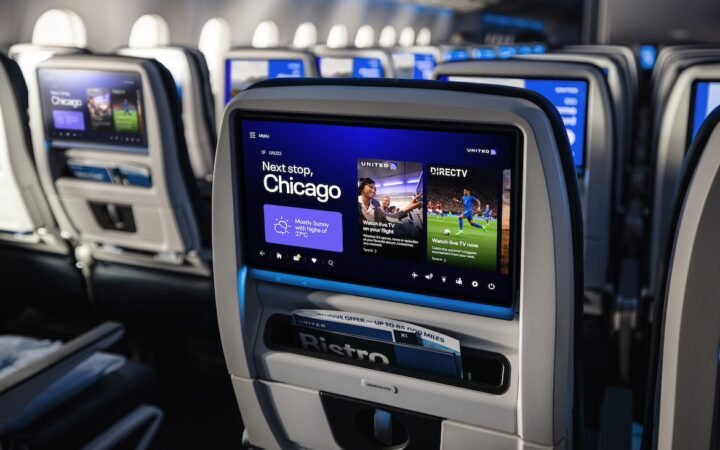
United Airlines is testing a more connected version of inflight entertainment by bringing live TV, sports and news to Starlink-enabled seatback screens this summer. The airline has partnered with DIRECTV to stream live programming on as many as 150 Starlink-equipped aircraft through July 20, giving passengers a look at how fast satellite Wi-Fi could change the onboard experience.
The timing is built around live sports demand, with soccer fans able to follow the summer’s major tournament while flying. Through DIRECTV IN FLIGHT and BBC content, customers on eligible aircraft can access more than a dozen live channels, including FOX, Fox Sports 1, Apple F1, ABC, ESPN, TNT, CNN, CBS, NBC, TBS, BBC and BBC News. The mix covers live soccer, sports, news, weather, business and entertainment.
The move is especially important because United is not only offering streaming on personal devices. It is using Starlink connectivity to power live content directly on seatback screens, making the aircraft cabin feel closer to a connected media environment than a traditional inflight entertainment system.
Seatback Screens Become Dynamic Again
United has spent years defending and expanding seatback screens at a time when some airlines shifted more heavily toward bring-your-own-device entertainment. The carrier now has more than 160,000 screens across its fleet and plans to roughly double that number through aircraft deliveries and retrofits.
The DIRECTV partnership shows why that investment matters. Static on-demand libraries remain useful, but live sports, news and real-time entertainment give seatback screens a different role. They become active, connected surfaces rather than fixed content menus.
United’s chief commercial officer, Andrew Nocella, framed the initiative as part of a longer strategy. The airline’s decision to install screens in every seat was not only about movies and television archives. The bigger goal is to combine hardware with reliable connectivity so passengers can watch the same types of live content they expect on the ground.
The technology behind the rollout uses web-enabled applications from Viasat Live TV and Thales 360 to present live content through seatback screens, with Starlink providing the connection to the aircraft. That combination reflects a broader shift in aviation, where connectivity, entertainment platforms and loyalty programs are increasingly becoming part of the same customer experience.
Starlink Raises the Wi-Fi Race
United signed a major agreement with SpaceX in 2024 to bring Starlink Wi-Fi to its mainline and regional aircraft, free for MileagePlus members. Starlink is already active on more than 400 United and United Express aircraft, and the airline expects to equip its full fleet before the end of 2027.
The live TV trial builds on that rollout. Starlink’s low-Earth orbit satellite network is designed to provide faster and more reliable connectivity than older inflight systems, including on routes where traditional Wi-Fi can struggle. For passengers, that opens the door to live matches, breaking news, business updates and entertainment that does not require preloaded content.
For United, the benefit is competitive. Airlines are increasingly fighting over the quality of time spent in the air, especially as Wi-Fi becomes free or tied to loyalty membership. If passengers can stream live sports from a seatback screen without relying only on their phone or tablet, United gains another way to distinguish its onboard product.
The test also hints at where inflight entertainment is heading. The next phase may not be about who has the biggest library of shows. It may be about which airlines can make the cabin feel connected in real time, with live content, fast Wi-Fi and screens that do more than pass the hours.
Disclaimer: TravelCapybara is an independent media brand owned and operated by NuvexMedia LLC, publishing travel news, destination guides, research, and insights. NuvexMedia LLC may invest in or collaborate with companies across the travel, hospitality, technology, and digital media sectors. These relationships do not influence TravelCapybara’s editorial coverage. While we strive for accuracy, travel requirements, prices, schedules, availability, and local conditions may change without notice. Readers should independently verify information before making travel or purchasing decisions. This content is for informational purposes only and does not constitute professional advice. © 2026 NuvexMedia LLC. All rights reserved.