London Museum has finally set an opening date for its long-awaited move to Smithfield, confirming that its new permanent galleries will open to the public on November 28, 2026. The milestone comes more than a decade after the institution first announced plans to relocate from its former London Wall site and nearly four years after that building closed to visitors.
The new museum will occupy the restored General Market at Smithfield, one of London’s most historically layered districts. The Victorian market building, designed by Sir Horace Jones and opened in 1883, had been closed to the public since the 1990s and had fallen into disrepair. Its transformation into a museum is being led by Stanton Williams, Asif Khan and conservation architect Julian Harrap.
The redevelopment has cost about £437 million and has been funded through a combination of public money and philanthropic support. Backers include the City of London Corporation, the Mayor of London and major cultural funders. The project is being described as one of Europe’s most ambitious cultural reimaginings, not only because of its scale, but because it turns a disused market into a new public destination.
A Historic Market Becomes a Museum
The move gives London Museum a setting closely tied to the city’s own story. Smithfield has been a place of trade, food, exchange and public life for almost a millennium. The surrounding area includes hundreds of listed buildings, conservation areas, ancient monuments and historic gardens, making it a fitting location for a museum dedicated to London’s past and present.
The restoration has involved more than 70 trades, including coppersmiths, stonemasons and blacksmiths working on historic details such as decorative ironwork and shopfronts. The project has also uncovered major heritage features, including an 800-square-meter network of underground vaults.
Sustainability is part of the redesign. The museum is reusing existing historic buildings rather than constructing a new structure, while adding measures such as rainwater-powered toilets, geothermal energy and lower-impact concrete. The adjoining Poultry Market, with its large concrete dome, is expected to open as a later phase in 2028.
Three Spaces Built Around London’s Story
The new museum will be organized around three connected spaces: Real Time, Our Time and Past Time. Real Time will serve as the main entrance, using a covered former street as a public threshold into the museum. Our Time, located in the restored market hall beneath the dome, will act as a social hub with events, food, a shop and large installations that reflect London’s energy and contradictions.
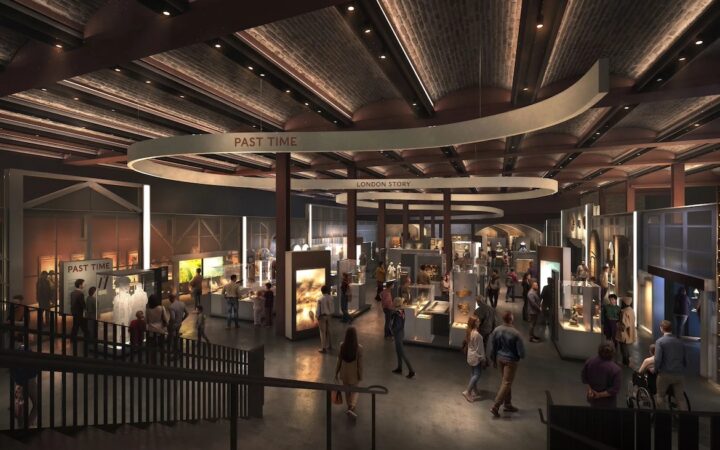
Past Time will sit below ground at Roman street level and will house the permanent galleries. Displays will explore the city from prehistoric settlement and Roman London through major events such as the Great Fire, the Blitz and the London 2012 Olympic and Paralympic Games. The galleries will also examine London as a center of protest, activism and creativity.
Highlights are expected to include Banksy’s Piranhas artwork, Roman writing tablets and major objects from the museum’s archaeological archive. One of the more unusual features will be a viewing window where visitors can see Thameslink trains passing beside the galleries.
The museum will also operate into the evening, with Friday and Saturday late openings and a day-to-night program involving local partners. Planned activities include workshops, performances, family playdates, sensory storytelling, food programming and nightlife-linked events.
For travelers, the opening adds another major cultural stop to London’s 2026 calendar. For the city, it is more than a museum move. It is the revival of a landmark market, a new reason to explore Smithfield and a reminder that London’s history is still being actively rebuilt.
Disclaimer: TravelCapybara is an independent media brand owned and operated by NuvexMedia LLC, publishing travel news, destination guides, research, and insights. NuvexMedia LLC may invest in or collaborate with companies across the travel, hospitality, technology, and digital media sectors. These relationships do not influence TravelCapybara’s editorial coverage. While we strive for accuracy, travel requirements, prices, schedules, availability, and local conditions may change without notice. Readers should independently verify information before making travel or purchasing decisions. This content is for informational purposes only and does not constitute professional advice. © 2026 NuvexMedia LLC. All rights reserved.