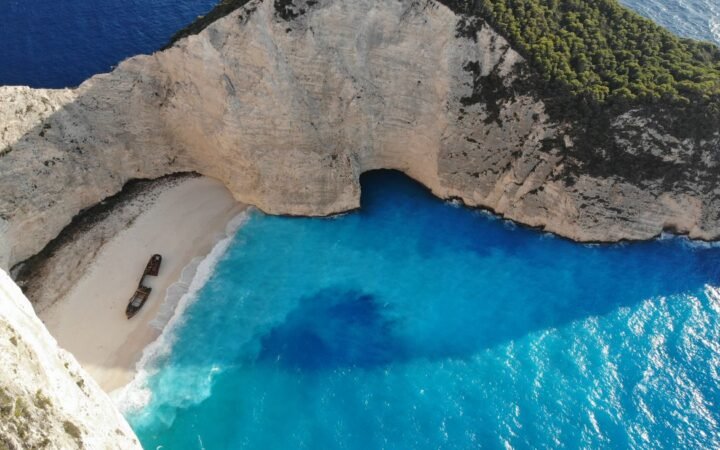
Greece is preparing a major intervention at one of its most photographed beaches, with plans to extend Navagio Beach on Zakynthos by 30 meters in an effort to protect its famous shipwreck. The project is designed to move the rusting MV Panagiotis farther from the sea and reduce the wave damage that has been steadily eating away at the vessel.
Navagio Beach, also known as Shipwreck Beach, became world famous after the Panagiotis ran aground there in October 1980. Since then, the stranded ship has become a symbol of Zakynthos and one of Greece’s most recognizable coastal landmarks. Its location below dramatic limestone cliffs, surrounded by pale sand and bright blue water, has helped turn it into a must-see image for travelers, even when direct access is not allowed.
The new plan calls for 45,000 cubic meters of gravel to be added to the beach, extending the shoreline toward the sea. The goal is to increase the distance between the water and the ship’s deteriorating hull, which is currently about 25 meters from the sea. Once the shoreline work is complete, authorities expect restoration work on the shipwreck itself to begin.
The project comes while Navagio remains closed to visitors for the 2026 summer season. Greek authorities have banned boats and swimmers from entering the beach area until at least October 31 because of continuing landslide concerns. Inspections by the Earthquake Planning and Protection Organisation identified the area as being at risk of extensive cliff movement.
Safety has been a recurring issue at the site. Navagio Beach was closed in 2018 after a cliff collapse injured seven people, and a magnitude 5.4 earthquake in 2022 again forced temporary restrictions. Visitors can still view the beach from above, but attempts to climb down are prohibited and can lead to penalties.
For Zakynthos, the challenge is delicate. Navagio is not only a beach but a global tourism image, one that helps define the island’s appeal. At the same time, the landscape is unstable, the ship is deteriorating and uncontrolled access could damage both the natural environment and visitor safety.
Local officials have framed the project as a more responsible approach to managing one of the island’s most valuable assets. The Municipality of Zakynthos, working with the National Technical University of Athens, is expected to help guide plans for coastal protection and preservation.
The proposed expansion signals a wider reality for heavily visited natural landmarks. Popularity can create pressure that threatens the very features travelers come to see. In Navagio’s case, saving the postcard view now requires engineering, restoration and stricter visitor control. If the plan succeeds, Greece may preserve one of its most iconic beach scenes while accepting that access to fragile destinations can no longer be treated as unlimited.
Disclaimer: TravelCapybara is an independent media brand owned and operated by NuvexMedia LLC, publishing travel news, destination guides, research, and insights. NuvexMedia LLC may invest in or collaborate with companies across the travel, hospitality, technology, and digital media sectors. These relationships do not influence TravelCapybara’s editorial coverage. While we strive for accuracy, travel requirements, prices, schedules, availability, and local conditions may change without notice. Readers should independently verify information before making travel or purchasing decisions. This content is for informational purposes only and does not constitute professional advice. © 2026 NuvexMedia LLC. All rights reserved.