China is preparing to open what is being described as the world’s first fully robot-serviced hotel, a project that could become one of the most visible tests yet of automation in hospitality. The hotel is planned for 2027 on West Artificial Island, a man-made island linked to the Shenzhen-Zhongshan Link in Guangdong Province.
The project is being developed by Pudu Robotics with Shenzhen Culture & Tourism Industry Development. It is planned as a “full-scenario robot-serviced hotel,” meaning robots will not simply assist human staff but handle nearly every guest-facing and operational role. Trial rooms and selected robot-powered services are expected to open to the public in late 2026 before the broader launch.
The location is fitting. Shenzhen is already one of China’s major technology hubs, and service robots are increasingly common in hotels, restaurants and public spaces across large Chinese cities. But this project goes further by designing the hotel itself around a connected robot service ecosystem.
Robots Will Handle the Guest Journey
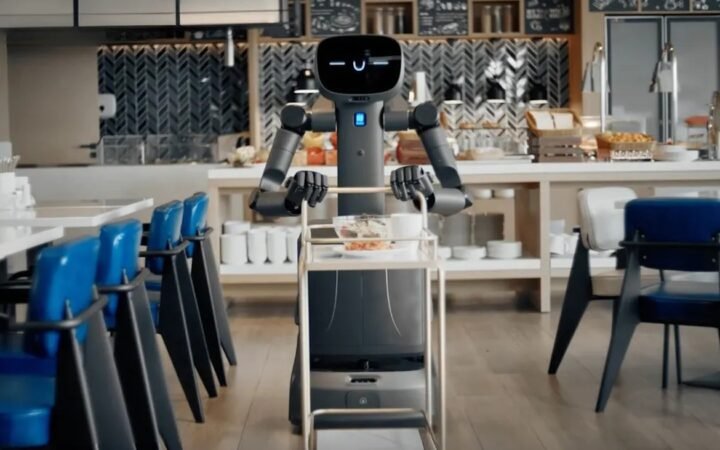
The hotel is expected to include 44 high-end rooms, a restaurant, gym and other guest spaces. Robots will be used for reception, check-in, room service, cleaning, food preparation, luggage delivery and guest support. Guests could arrive, check in, send luggage to their room, order drinks by phone and receive in-room deliveries without interacting with a traditional front desk.
Pudu’s robot lineup gives a clearer sense of how the system may work. FlashBot will support an intelligent vending and delivery model, allowing guests to order drinks by smartphone. PUDU T300 will transport luggage from the lobby to rooms. Cleaning robots such as PUDU CC1 Pro and PUDU MT1 will handle waste detection and room upkeep using AI-supported systems.
The hotel will rely on PuduFM 1.0, the company’s embodied intelligence foundation model, and PuduAgent for intelligent operations. The goal is to let different robots share a common software framework while performing different tasks. Reception robots may interpret gestures and social interactions, delivery robots can optimize routes, and cleaning robots can adjust to changing environments.
Hospitality Automation Gets a Real-World Test
For travelers, the appeal could be speed and consistency. A robot-run hotel may reduce waiting at check-in, make late-night deliveries easier and provide round-the-clock service without depending on staffing levels. For guests who value convenience and technology, the experience could feel efficient and futuristic.
But the model also raises major questions. Hospitality has traditionally depended on human judgment, warmth and problem-solving. A robot can deliver luggage or clean a hallway, but guests may still want a person when plans change, a child gets sick, a room issue becomes complicated or a local recommendation needs nuance.
Privacy and data use will also matter. A hotel run through AI systems, sensors, guest apps and robotic operations may create a smoother stay, but travelers will want to know how their information is collected, stored and used.
The wider plan for West Artificial Island suggests the hotel is only one part of a broader technology tourism concept. Over the next several years, robotics are expected to be introduced across service and tourism on the island, turning the area into a showcase for automated travel experiences.
If the hotel works, it could influence airports, resorts, cruise terminals and city hotels far beyond China. If it feels cold or limited, it may prove that automation can support hospitality but not fully replace it. Either way, the 2027 opening will be watched closely because it asks a question the industry can no longer avoid: how much of a hotel stay do travelers really want handled by machines?
Disclaimer: TravelCapybara is an independent media brand owned and operated by NuvexMedia LLC, publishing travel news, destination guides, research, and insights. NuvexMedia LLC may invest in or collaborate with companies across the travel, hospitality, technology, and digital media sectors. These relationships do not influence TravelCapybara’s editorial coverage. While we strive for accuracy, travel requirements, prices, schedules, availability, and local conditions may change without notice. Readers should independently verify information before making travel or purchasing decisions. This content is for informational purposes only and does not constitute professional advice. © 2026 NuvexMedia LLC. All rights reserved.