Key Notes
- Delta’s aircraft weight-and-balance automation problem delayed hundreds of flights before Thanksgiving, with employees using manual procedures and the FAA temporarily restricting Atlanta-bound Delta traffic.
- The FAA issued its Atlanta ground-delay cancellation notice at 11:28 AM Eastern, while airport-wide delay totals continued to rise and did not establish that Delta’s automated system had fully recovered.
- The initial FAA notice’s 3,574 total-delay value is not a flight-count field, so early reports of 3,500 affected flights should not be presented as a confirmed tally.
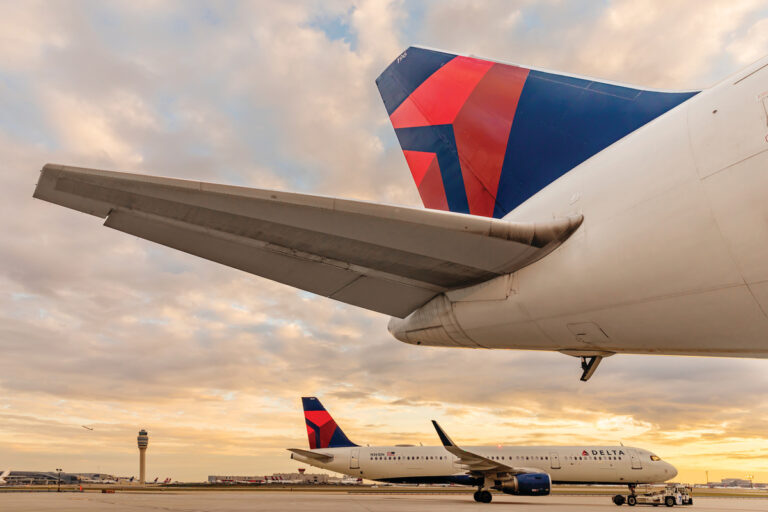
Delta Air Lines delayed hundreds of flights on Sunday, November 22, after a problem with its aircraft weight-and-balance automation system disrupted departures and traffic through its Atlanta hub. The airline used manual procedures to keep aircraft moving as teams worked to restore the automated process.
The disruption arrived as Thanksgiving travel was gathering pace. It prompted a temporary ground stop for Delta and its regional affiliates flying toward Hartsfield-Jackson Atlanta International Airport, followed by a ground-delay program. The FAA issued a cancellation notice for that program at 11:28 a.m. Eastern.
What Went Wrong at Delta
The affected system supports the calculations crews need before departure to establish how much an aircraft weighs and how its load is distributed. It is part of preparing a flight for a safe takeoff, so losing automation can slow dispatch even when the aircraft itself is ready.
In a company statement carried by Atlanta News First, Delta said employees were using manual workarounds while restoration work continued. The airline also said it was coordinating with air traffic control to manage congestion around airport gates and the tarmac.
The FAA said the delays were unrelated to its own air traffic systems. This was an airline-system problem, with traffic restrictions applied to the affected carrier’s flights, rather than another halt to all U.S. departures.
The Atlanta Restriction Has Been Lifted
The FAA’s ground-delay advisory covered Delta mainline and regional-affiliate flights into Atlanta from the contiguous United States. It assigned an average delay of 57 minutes and a maximum of 111 minutes.
A subsequent cancellation notice, issued at 11:28 a.m. Eastern, told operators to disregard the program’s assigned departure-clearance times for Atlanta. The notice said the carrier-request objectives had been met. Ending that traffic-management program does not, by itself, confirm that Delta’s automation has fully recovered or that accumulated delays have cleared.
What the Flight-Delay Figures Actually Show
At 2:03 p.m. Eastern, FlightAware’s Atlanta tally showed 978 delayed flights and 26 cancellations for the day. Those airport-wide figures cover arrivals and departures across airlines; they should not all be attributed to Delta’s system issue.
A late-morning report citing FlightAware listed 681 Atlanta delays and 591 Delta delays nationwide by 11 a.m. Eastern. Those figures describe different, overlapping groups. They cannot be added together to produce a unique total.
Some early headlines referred to 3,500 affected flights. However, the FAA’s initial ground-stop record places 3,574 in its total-delay field, alongside maximum and average delay values. It does not label that figure as a flight count, and it does not substantiate a confirmed total of 3,500 delayed flights.
Another Disruption Before the Holiday Rush
The incident follows the FAA communications failure that halted U.S. departures on November 13 and a separate United Airlines outage on November 16. The sequence has brought renewed attention to aviation’s dependence on connected operational systems, but the timing alone does not establish a shared cause.
Passengers should check their individual flight and any onward connection with Delta before heading to the airport. A lifted ground stop allows the operation to recover; it does not guarantee that a particular departure, aircraft or connecting itinerary is back on schedule.
Disclaimer: TravelCapybara is an independent media brand owned and operated by NuvexMedia LLC, publishing travel news, destination guides, research, and insights. NuvexMedia LLC may invest in or collaborate with companies across the travel, hospitality, technology, and digital media sectors. These relationships do not influence TravelCapybara’s editorial coverage. While we strive for accuracy, travel requirements, prices, schedules, availability, and local conditions may change without notice. Readers should independently verify information before making travel or purchasing decisions. This content is for informational purposes only and does not constitute professional advice. © 2026 NuvexMedia LLC. All rights reserved.