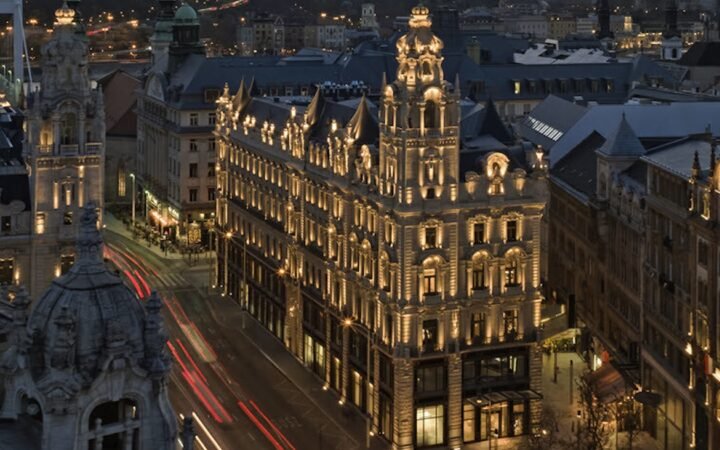
St. Regis has officially entered Hungary with the opening of The St. Regis Budapest, a high-profile debut that places one of Marriott’s most established luxury brands inside one of the city’s best-known historic landmarks. The hotel occupies Klotild Palace, a Neo-Baroque building on the Pest side of the Danube that once served as a ceremonial gateway for travelers crossing the Elisabeth Bridge.
For Budapest, the opening adds another major luxury address to a city already growing in appeal among high-end leisure travelers, cultural visitors, and river cruise guests looking to extend their stay before or after a voyage.
The setting is central to the project’s appeal. Klotild Palace is not just another heritage conversion. It is a UNESCO-listed architectural site tied closely to Budapest’s Austro-Hungarian past, commissioned at the turn of the 20th century by Princess Klotild of Saxe-Coburg and Gotha.
The building’s tower, crown motifs, and formal grandeur make it one of the city’s most recognizable historic façades. St. Regis is clearly leaning into that lineage, presenting the property not simply as a luxury hotel in Budapest, but as a restored palace with a stronger narrative than many modern luxury developments can offer.
A Historic Palace Recast as a Modern Luxury Hotel
The new hotel includes 63 rooms and 39 suites, making it relatively intimate by large-city luxury standards. Among the standout accommodations are the Klotild Tower Suite and the two-bedroom Presidential Suite, which extends across more than 169 square meters and includes a private balcony with views of the Danube, Elisabeth Bridge, and the Citadella. Across the property, the design references both Budapest’s artistic heritage and the movement of the river, blending soft blue tones, ceramics, brass details, and Art Nouveau influences into a look that aims to feel rooted in the city rather than internationally generic.
St. Regis is also importing its usual brand markers, including Butler Service, Afternoon Tea, and Champagne Sabrage, but with local interpretation. The hotel’s signature cocktail, the Crown Mary, is its Budapest answer to the Bloody Mary tradition that runs through the brand globally. That local adaptation is important because it signals what this opening is trying to achieve: not just place a St. Regis in Budapest, but create a Budapest version of St. Regis.
The food and beverage lineup helps support that ambition. The St. Regis Bar is positioned as an evening social centerpiece, while 99 Sushi Bar & Restaurant adds an upscale international dining option. Klotild Patisserie, set inside a historic apothecary-style space, may prove just as significant for the hotel’s local relevance, especially given Budapest’s strong café and pastry culture.
Why the Opening Matters for Budapest’s Luxury Market
The timing of the opening is notable. Budapest continues to benefit from a blend of cultural tourism, wellness appeal, and rising visibility in the luxury segment, but its hotel pipeline still has fewer internationally recognized ultra-luxury names than some other European capitals. St. Regis changes that. It brings a globally legible brand to a city that increasingly attracts affluent travelers who want both historic depth and full-service luxury.
The hotel is also likely to appeal to river cruise passengers, particularly those ending Danube itineraries in Budapest and looking for an extra night or two in a more elevated setting. That overlap could be commercially important. Budapest already works well as a cruise turnaround and extension city, and a palace hotel with a strong spa, major suites, and central location gives the market another reason to hold high-value guests longer.
The St. Regis Spa strengthens that positioning. Drawing on Budapest’s bath culture, it includes an indoor pool, hammam, Finnish sauna, experience showers, and treatment rooms, with products from both Sothys and Hungarian skincare brand Omorovicza. In a city known for thermal heritage, that local wellness connection feels especially well judged.
Ultimately, The St. Regis Budapest is more than a brand expansion. It is a statement opening that ties international luxury hospitality to one of the city’s most symbolic historic buildings, giving Budapest a new flagship address in the process.
Disclaimer: TravelCapybara is an independent media brand owned and operated by NuvexMedia LLC, publishing travel news, destination guides, research, and insights. NuvexMedia LLC may invest in or collaborate with companies across the travel, hospitality, technology, and digital media sectors. These relationships do not influence TravelCapybara’s editorial coverage. While we strive for accuracy, travel requirements, prices, schedules, availability, and local conditions may change without notice. Readers should independently verify information before making travel or purchasing decisions. This content is for informational purposes only and does not constitute professional advice. © 2026 NuvexMedia LLC. All rights reserved.