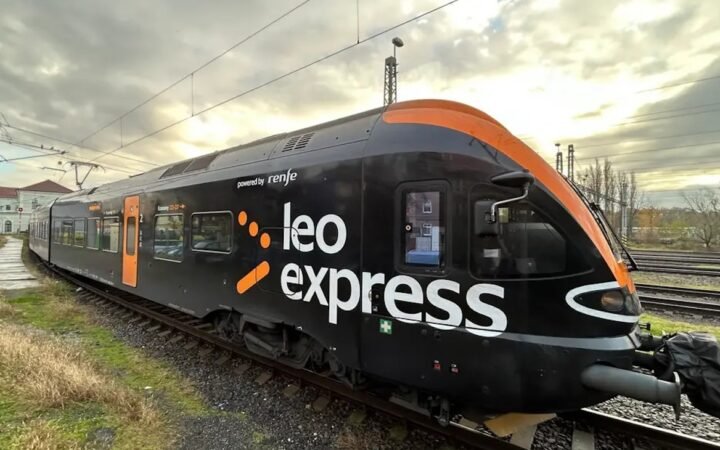
Leo Express is adding a new cross-border rail service between Prague and Bratislava, giving travelers in Central Europe another direct option between the Czech and Slovak capitals. The privately owned Czech operator will begin running the new route on April 30, using Talgo IV trainsets leased from Spain’s Renfe, which holds a 50 percent stake in Leo Express. The launch is part of a wider growth push by the company as it expands services across regional and international markets in 2026.
The new route will run from Prague Main Station to Bratislava hl.st., with intermediate stops including Pardubice, Olomouc, Otrokovice, and Staré Město u Uherského Hradiště. Total journey time is set at 5 hours and 42 minutes. That timing keeps the route competitive as a rail alternative for travelers who value city-center access and a direct service over the airport-to-airport model. The service also extends Leo Express’s footprint in a corridor where cross-border travel remains important for business, visiting friends and relatives, and regional leisure traffic.
The trains themselves are a key part of the launch. Leo Express is using Talgo sets that can reach speeds of up to 200 kilometers per hour and carry around 350 passengers across 13 carriages. According to the operator, the trains bring features that remain relatively unusual in Central Europe, including low-floor accessibility, generous passenger space, and a passive tilting system designed to improve comfort on curving routes. Traction will be provided by Siemens Vectron multi-system locomotives, making the trains suitable for international operations across different rail systems.
Leo Express is also presenting the new service as a comfort-led offer. The refurbished interiors include Economy and Business classes, leather headrests, an open-plan layout, and large seat spacing that the company says compares favorably even with first class on some other operators. Quiet zones are included for passengers who want to work or relax, while onboard catering will be available through direct seat service, a bistro car, and in some cases extra vending and self-service facilities. Families are also part of the target market, with dedicated children’s areas and stroller-friendly spaces built into the design.
The Prague-Bratislava launch is only part of a broader deployment plan for the Talgo fleet. One trainset will also be used on Leo Express’s Prague-Prešov service, which resumes on April 30 after a two-month suspension caused by infrastructure works. A third train is expected to support the company’s expansion into the German market later this summer, with a planned route linking Przemyśl in southeastern Poland with Frankfurt from June 25.
Together, those additions show that Leo Express is thinking beyond isolated route launches and is instead building a wider international growth platform. The operator expects its total passenger volumes to rise by at least 1.5 million in 2026, taking annual traffic above six million travelers.
For the Prague-Bratislava route specifically, the appeal lies in a combination of direct connectivity, upgraded rolling stock, and a more premium onboard offer than many travelers may expect from a regional rail operator. In a Central European market where passengers increasingly compare trains not just on speed but on comfort and convenience, that could prove to be a meaningful advantage.
Disclaimer: TravelCapybara is an independent media brand owned and operated by NuvexMedia LLC, publishing travel news, destination guides, research, and insights. NuvexMedia LLC may invest in or collaborate with companies across the travel, hospitality, technology, and digital media sectors. These relationships do not influence TravelCapybara’s editorial coverage. While we strive for accuracy, travel requirements, prices, schedules, availability, and local conditions may change without notice. Readers should independently verify information before making travel or purchasing decisions. This content is for informational purposes only and does not constitute professional advice. © 2026 NuvexMedia LLC. All rights reserved.