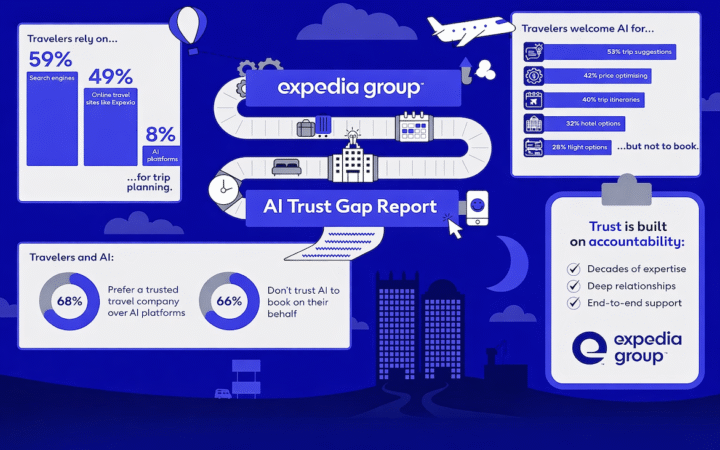
Expedia Group says travelers are increasingly willing to use AI as a planning tool, but still hesitate when it comes to letting that same technology handle the actual booking. Its new AI Trust Gap report, based on a survey of more than 5,700 adults across the U.S., U.K., and India, points to a clear pattern: AI is gaining traction in travel discovery, but trust still sits firmly with established travel brands when money and accountability enter the picture.
That distinction may be one of the most important travel-tech stories of 2026. For years, the industry has assumed that if AI got good enough at recommendations, it would naturally move deeper into transactions. Expedia’s findings suggest the path is not that simple. Travelers appear open to using AI in a supporting role, especially for time-saving tasks like suggesting destinations, building itineraries, or tracking prices. But once a trip moves from inspiration to payment, they still want the protection, familiarity, and customer service infrastructure of a known booking platform.
The report lays out the contrast clearly. More than half of travelers said they are comfortable with AI suggesting travel options. A meaningful share said they would use it to monitor prices or help shape an itinerary. Nearly half said AI can save time and surface places they may not have otherwise discovered. Yet only a small minority currently rely on AI chatbots or agents for trip planning, and even fewer feel comfortable letting them actually make a purchase. Expedia says 68 percent of travelers still prefer to book with a trusted travel brand over an AI chatbot or agent, while 66 percent say they would not trust AI to buy or book anything on their behalf.
Planning Is One Thing, Payment Is Another
That gap reflects how travelers think about risk. Travel is not a low-stakes purchase. A wrong hotel, a failed booking, a mistimed flight, or a support problem during a disruption can quickly become expensive and stressful. In that context, people are not just asking whether AI can make a booking. They are asking who fixes it if something goes wrong.
Expedia’s data suggests the biggest concerns are loss of control, privacy around data and payment details, and misuse of personal information. There is also concern about what happens after the transaction, particularly if customer service is weak or unclear. In other words, the issue is not purely technological. It is operational and emotional. Travelers want to know there is accountability behind the booking, not just automation.
What This Means for the Travel Industry
The practical takeaway is that travel discovery is fragmenting. People may start their search on AI assistants, search engines, social platforms, or travel sites, but they are still gravitating toward trusted brands when it is time to complete the purchase. That creates a more complicated distribution environment, but also a major opportunity for travel companies that can combine AI-powered inspiration with dependable service and fulfillment.
For Expedia, the message is also strategic. The company is clearly acknowledging that AI alone is not enough to win the booking moment. The real advantage lies in blending AI interfaces with the pricing, supplier relationships, support systems, and operational scale that travelers already trust. The next phase of travel AI may therefore be less about replacing travel brands and more about embedding them wherever trip decisions begin.
If that holds true, the winners will not simply be the companies with the smartest chatbot. They will be the ones that make travelers feel comfortable enough to click book.
Disclaimer: TravelCapybara is an independent media brand owned and operated by NuvexMedia LLC, publishing travel news, destination guides, research, and insights. NuvexMedia LLC may invest in or collaborate with companies across the travel, hospitality, technology, and digital media sectors. These relationships do not influence TravelCapybara’s editorial coverage. While we strive for accuracy, travel requirements, prices, schedules, availability, and local conditions may change without notice. Readers should independently verify information before making travel or purchasing decisions. This content is for informational purposes only and does not constitute professional advice. © 2026 NuvexMedia LLC. All rights reserved.