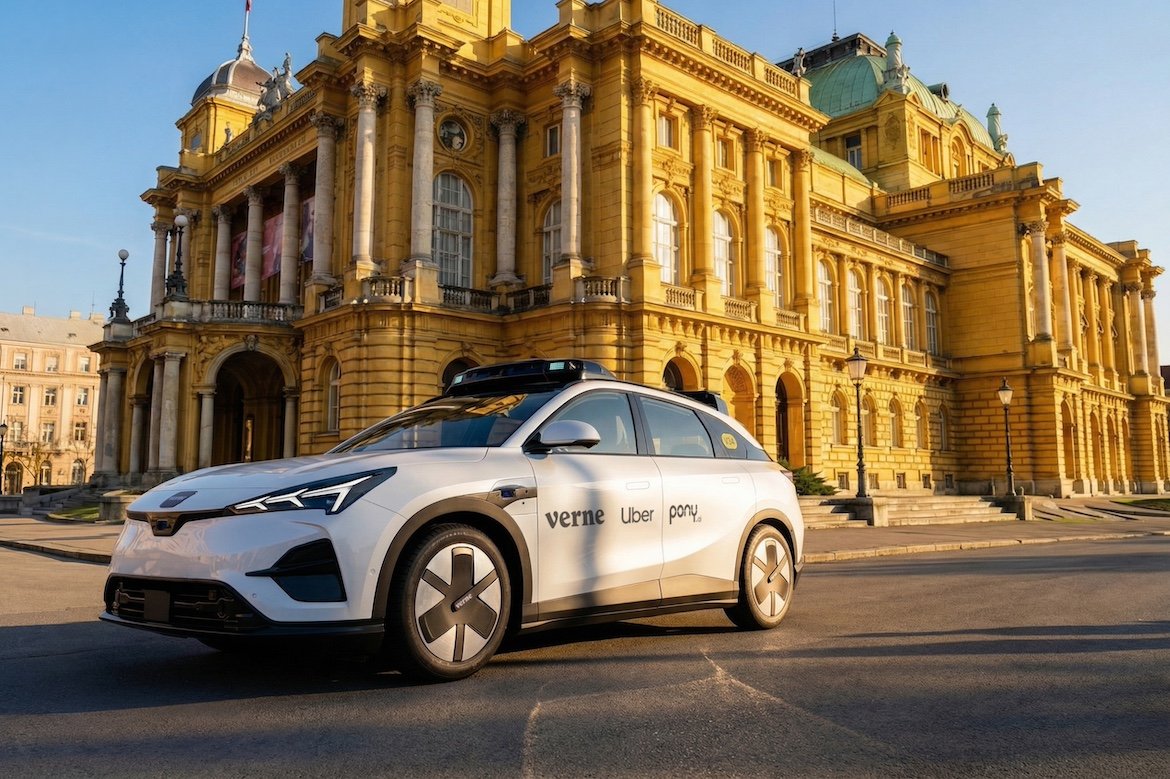

Uber, Pony.ai and Croatian startup Verne are preparing to launch what they describe as Europe’s first commercial robotaxi service, with Zagreb set to become the first market. The partnership combines three separate roles: Pony.ai will provide the autonomous driving system, Verne will own and operate the fleet, and Uber will connect the service to its ride-hailing platform. Public-road testing is already under way, while preparations for paid rides are moving forward.
The deal matters because it reflects how Uber now approaches autonomous vehicles. Instead of trying to build the full stack itself, the company is assembling a network of technology providers, fleet operators and local partners, then positioning its app as the demand layer. In practical terms, Zagreb is not just a launch city. It is a live test of whether that partnership-heavy model can work in Europe, where regulation, urban design and market fragmentation make rollout harder than in the United States or China.
For Verne, the project is also a chance to move beyond the startup stage and become the local operating layer for autonomous mobility. That role may prove more valuable in Europe than the vehicle technology alone, because deployment depends as much on licensing, local coordination and service design as it does on autonomous software.
Why Zagreb Makes Strategic Sense
Zagreb offers a more controlled starting point than a larger Western European capital. It gives the partners a major city environment without the same level of congestion, political sensitivity and operational complexity they would face in places such as Paris, London or Berlin. That makes it a plausible proving ground for commercial service before expansion into tougher markets.
The city also gives Uber a European robotaxi entry point without forcing it to lead the most difficult part of the launch. Verne is expected to handle local readiness and regulatory coordination, which reduces some of the friction that usually slows autonomous deployments. Pony.ai, meanwhile, brings a system that has already been commercialized at scale elsewhere, which helps the group argue that this is not an experimental concept being introduced from scratch.
That division of labor is likely the most important part of the announcement. Each company is staying close to its core competence, which improves the odds that the first phase is operationally disciplined rather than overly ambitious.
The Real Test Comes After the Launch
The stronger question is not whether the service can start, but whether it can expand. Europe is rarely a single market in mobility terms. Rules differ by country, city politics matter, and public acceptance of autonomous vehicles remains uneven. A successful launch in Zagreb would still leave open the harder task of replicating the model across multiple jurisdictions.
There is also a commercial issue beneath the technology story. Robotaxi projects often generate strong headlines long before they prove reliable unit economics. Uber is betting that it can avoid some of that risk by acting as distributor rather than developer, while Pony.ai and Verne take on more of the technical and operational burden. That may be a more disciplined way to participate in autonomous transport, but it does not remove the underlying challenge of turning pilot operations into repeatable urban service.
For now, Zagreb is best viewed as a strategic foothold rather than a continental breakthrough. If the service launches smoothly, Europe will have its first meaningful test of whether robotaxis can move from demonstration to routine transport. If it struggles, the lesson may be that autonomous mobility in Europe remains easier to announce than to scale.