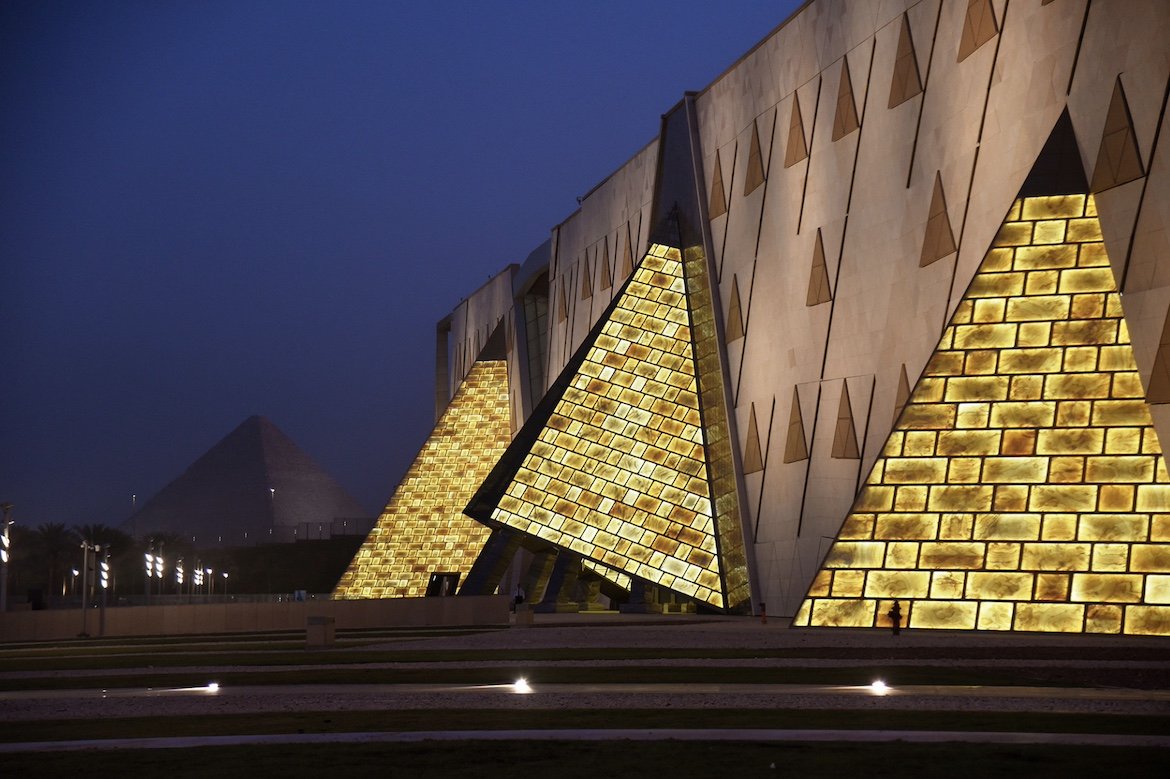
After more than twenty years of planning, delays, and anticipation, Egypt has officially opened the Grand Egyptian Museum (GEM) – a monumental cultural complex designed to showcase over 7,000 years of history. Overlooking the Giza Pyramids, this $1 billion project represents the largest archaeological museum in the world dedicated to a single civilization, blending ancient heritage with modern innovation.
World leaders, royals, and dignitaries gathered on Saturday for a dazzling opening ceremony featuring orchestras, fireworks, laser displays, and traditional pharaonic performances. Egyptian President Abdel Fattah al-Sisi described the museum as “a new chapter in the story of this ancient nation’s present and future,” emphasizing that it symbolizes both national pride and Egypt’s renewed commitment to cultural diplomacy.
A New Home for Egypt’s Timeless Treasures
The Grand Egyptian Museum spans roughly 470,000 square meters – about the size of Vatican City – and sits just one mile from the iconic pyramids. Its sleek, pyramid-inspired design by Dublin-based firm Heneghan Peng Architects contrasts sharply with the aging neoclassical Egyptian Museum in downtown Cairo. The new complex is a world-class facility that merges the timelessness of Egypt’s heritage with 21st-century technology.
Inside, more than 100,000 artefacts tell the story of Egypt’s civilization, from prehistoric times to the Roman era. Among them is an 83-ton, 3,200-year-old statue of Ramses II, now greeting visitors in the vast entrance hall, and the complete contents of Tutankhamun’s tomb – more than 5,000 objects, including the pharaoh’s golden mask, throne, and sarcophagus – displayed together for the first time since their discovery in 1922.
The museum also features 12 grand galleries, an immersive children’s museum, research labs, and a large conservation center. According to GEM CEO Ahmed Ghoneim, the museum’s digital exhibits and mixed-reality displays aim to “speak the language of new generations,” inviting visitors to experience Egypt’s history in innovative and interactive ways.
Reviving Tourism and Cultural Confidence
The museum’s completion marks not just a cultural milestone but a strategic investment in Egypt’s tourism economy. The country, which welcomed a record 15.7 million visitors in 2024, hopes to double that number by 2032. Officials expect between 15,000 and 20,000 visitors a day, with the GEM positioned as a cornerstone of Egypt’s tourism revival alongside infrastructure upgrades such as new metro lines and airports.
For Egypt, the project is deeply symbolic. After the challenges of the Arab Spring, the pandemic, and regional conflicts, the museum’s completion stands as a statement of resilience and renewal. It also serves as a response to the world’s great cultural institutions. As one local newspaper noted, “The GEM is not a replica of the Louvre or the British Museum. It is Egypt’s response to both – born not of empire, but of authenticity.”
Beyond its cultural and political significance, the Grand Egyptian Museum reflects Egypt’s long-standing effort to preserve and reclaim its heritage. Following years of controversy over looted artefacts and foreign holdings, the GEM reasserts the nation’s role as the guardian of one of humanity’s oldest and most influential civilizations.
As fireworks lit the night sky above Giza, the museum opened its doors to the world – not just as a home for ancient treasures, but as a symbol of Egypt’s enduring identity and ambition.