More than 2,400 flights were canceled across the Middle East over the weekend after joint U.S. and Israeli strikes on Iran triggered retaliatory missile attacks and sweeping airspace closures. The escalation has paralyzed one of the world’s most critical aviation corridors, stranding tens of thousands of travelers and forcing global airlines to suspend routes across the region.
Airspace over Iran, Iraq, Israel, Jordan, and parts of the Gulf emptied rapidly as governments moved to restrict civilian traffic. Airports in Dubai and Abu Dhabi in the United Arab Emirates, Doha in Qatar, and Manama in Bahrain were temporarily shut down, while Israel’s Ben Gurion Airport also suspended operations.
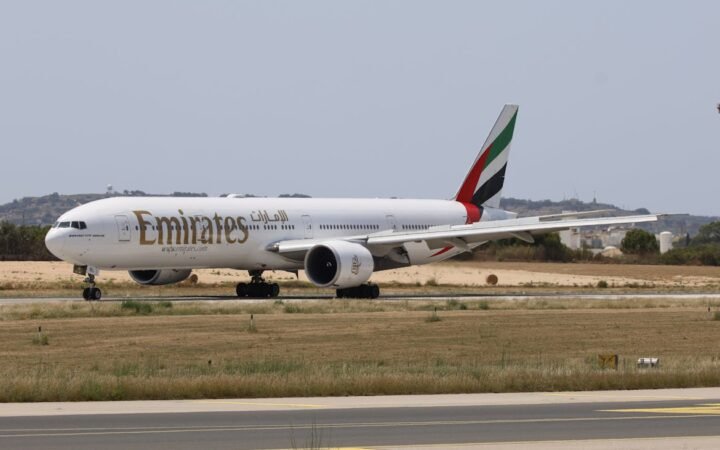
According to aviation data firm Cirium, Emirates, Qatar Airways, and Etihad collectively handle roughly 90,000 passengers daily through their hub airports, highlighting the scale of the disruption.
Major international carriers quickly announced suspensions. United Airlines halted flights to Tel Aviv through March 6 and paused service to Dubai through March 4. Delta Air Lines suspended its New York–Tel Aviv route, notifying affected travelers through its app and reservation systems. Lufthansa temporarily stopped flights to Dubai and suspended services to Tel Aviv, Beirut, and parts of Oman. Wizz Air, British Airways, Air France, KLM, Iberia, and Virgin Atlantic were among other airlines canceling or rerouting services.
The Middle East has become increasingly vital for long-haul routes between Europe and Asia, especially with Russian and Ukrainian airspace largely closed due to ongoing conflict. With these corridors now disrupted, airlines face costly detours, longer flight times, and mounting operational pressure. Flight-tracking data showed aircraft diverting around restricted zones, with some Qatar Airways planes departing only to circle and return amid shifting restrictions.
Airlines are urging passengers to verify flight status before heading to airports, as conditions continue to change rapidly. “For travelers, there’s no way to sugarcoat this,” airline industry analyst Henry Harteveldt said in comments to CBS News. “You should prepare for delays or cancellations for the next few days as these attacks evolve and hopefully end.”
The disruption extends beyond the region itself. Gulf hubs serve as transfer points for millions traveling between continents, meaning cancellations ripple outward to Europe, Asia, and North America. Travelers with connecting itineraries face missed onward flights, rebooking challenges, and limited alternative routes.
While some airports have partially reopened, uncertainty remains high. Governments continue to assess security risks, and further cancellations are possible if tensions escalate. For now, the region’s usually dense air traffic corridors remain fragile, underscoring how quickly geopolitical conflict can upend global travel networks.