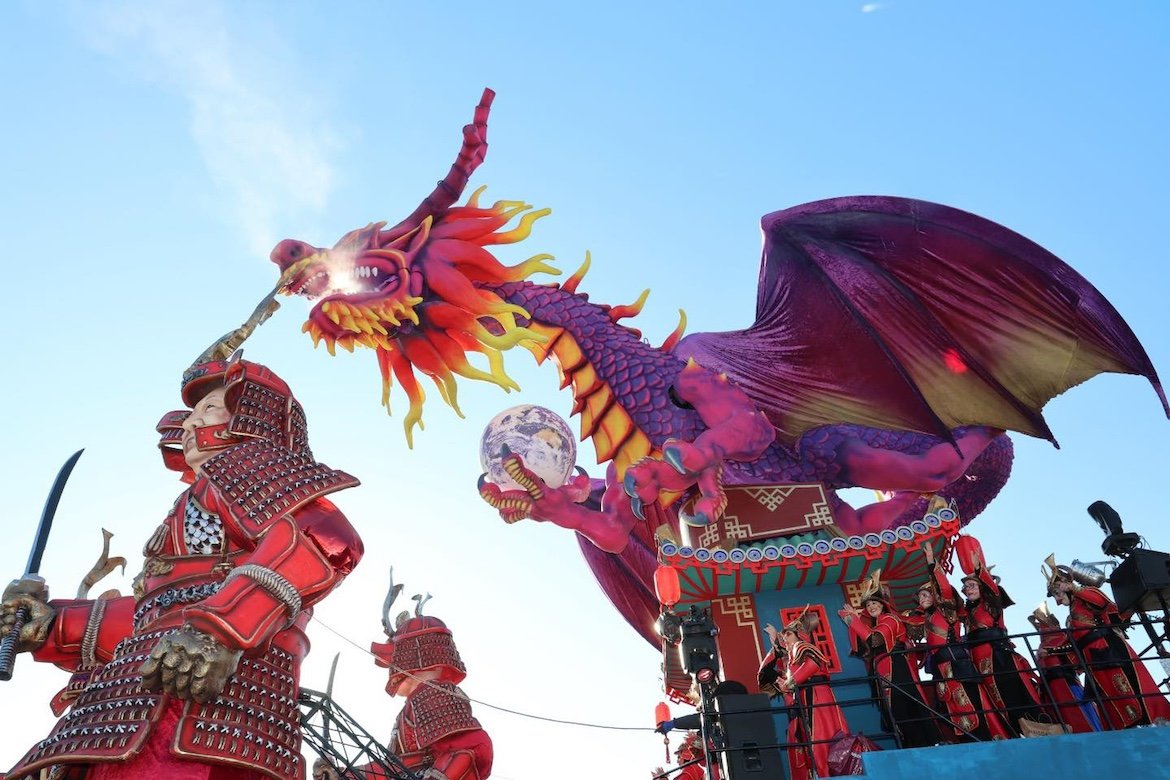
When people think of Carnival in Italy, the masked elegance of Venice often comes to mind first. Yet further south, on the Tuscan coast, Viareggio hosts a celebration that rivals Venice in scale, creativity, and cultural impact.
The Viareggio Carnival, held from February 1 to 21, 2026, transforms this seaside city into one of Europe’s most extraordinary open-air stages, attracting hundreds of thousands of visitors with its colossal allegorical floats, biting satire, and deeply rooted community spirit.
Monumental Floats and the Power of Satire
The heart of the Viareggio Carnival lies in its masked parades along the city’s seafront boulevards. Unlike the refined mystery of Venetian masks, Viareggio is defined by sheer scale and visual force. Towering papier-mâché floats, some reaching the height of small buildings, roll through the Viali a Mare carrying oversized figures that comment on politics, society, culture, and global events.
These are not decorative objects but moving narratives, crafted over months by teams of artists, engineers, and artisans who have perfected the art of papier-mâché for generations.
In 2026, six major parades are scheduled, including daytime and evening events that dramatically change the atmosphere of the city. Night parades, illuminated by theatrical lighting, amplify the surreal impact of the floats, while fireworks mark both the opening parade on February 1 and the grand finale on February 21.
Each float competes in official categories, with winners announced at the closing parade, reinforcing the Carnival’s long-standing blend of art, competition, and public spectacle.
A Carnival That Belongs to the City
Beyond the grand parades, Viareggio Carnival lives just as strongly in its neighborhoods. Local districts host street parties, live music, communal dinners, and events for children that extend the celebration far beyond the seafront. These neighborhood festivals reflect the Carnival’s popular soul, where residents and visitors mingle freely, and tradition is passed down through shared experiences rather than formal ceremonies.
For many locals, Carnival is not confined to a ticketed event but unfolds across the entire city throughout February. Afternoon parties for children, evening dances, and food-focused gatherings turn Viareggio into a living festival landscape. This grassroots dimension is what sets Viareggio apart from more tourist-oriented carnivals, preserving a strong sense of local identity even as international attendance grows.
The Citadel of Carnival and a Living Artistic Legacy
At the center of Viareggio’s Carnival culture stands the Citadel of Carnival, a vast creative complex dedicated to preserving and producing the event’s artistic heritage. Here, master builders construct the massive floats inside hangars that double as exhibition spaces, allowing visitors to witness the creative process firsthand. The on-site Carnival Museum traces more than 150 years of history, documenting how Viareggio evolved from a local celebration into one of Italy’s most influential cultural events.
Together, the parades, neighborhood festivals, and creative infrastructure make Viareggio Carnival far more than a seasonal attraction. It is a living expression of satire, craftsmanship, and collective identity, proving that Italy’s most powerful Carnival experience does not belong to Venice alone.