
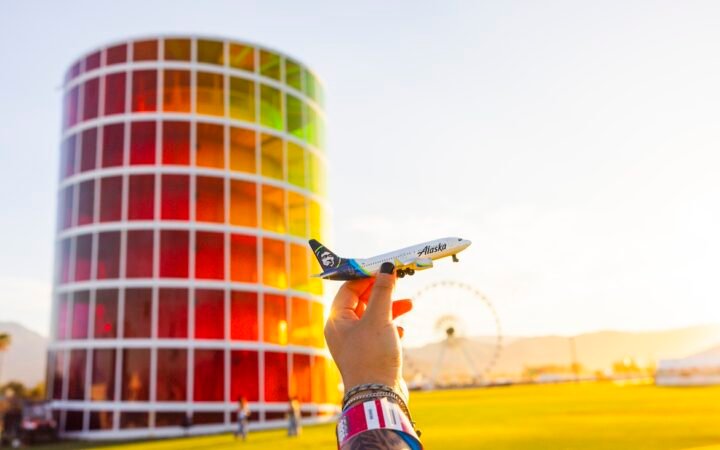
Alaska Airlines is returning as the official airline of both Coachella and Stagecoach, extending a partnership that gives the carrier a visible role at two of the most commercially powerful music festivals in the United States. This is the second year Alaska has held the title for both events, and the airline is again using the festivals not simply as sponsorship platforms, but as a way to turn the travel experience itself into part of the product.
At the center of the campaign is an immersive on-site activation designed to simulate the feeling of being 35,000 feet in the air. The installation is built as a full sensory experience and is meant to bring airline branding into a space that usually belongs to fashion, music, and lifestyle partnerships. That matters because Coachella and Stagecoach are no longer just festival weekends. They function as major consumer-brand environments, and airlines increasingly want to be seen there not as transport providers alone, but as cultural participants.
Alaska is also tying the activation to its wider network story. The carrier is highlighting newer long-haul destinations such as London, Rome, Tokyo, and Seoul, effectively using the desert festivals as a stage for international brand messaging. The idea is straightforward: a passenger flying to Palm Springs for a music weekend may also be a future customer for a larger leisure trip. In that sense, the campaign is not just about festival traffic. It is about linking short domestic trips with a broader premium and global positioning.
On the ground, Alaska is adding practical perks to support that message. Festivalgoers will be offered complimentary drinks and snacks during select times, along with access to a reimagined version of the airline’s in-flight Wi-Fi experience powered through its partnership with T-Mobile. Guests will also be able to compete for prize giveaways, including large loyalty point awards tied to the joint Alaska-Hawaiian program. These features help present the airline as both useful and entertaining, which is increasingly the balance brands are trying to strike at high-profile events.
There is also a clear network rationale behind the sponsorship. During the festival period in April, Alaska says it will offer the most seats into Palm Springs, which remains the main air gateway to the Coachella Valley. That gives the carrier a concrete operational presence behind the marketing. Unlike some festival sponsors that are mostly symbolic, Alaska can connect the branding directly to real transport volume and route relevance.
The broader significance is that airline marketing is continuing to shift away from purely functional messaging. Carriers still sell schedules, loyalty programs, and service, but they now increasingly want to insert themselves into moments that shape how people travel in the first place. In Alaska’s case, Coachella and Stagecoach provide access to a customer base that values experience, identity, and social visibility. For the airline, the desert is not just a destination this month. It is a brand stage.