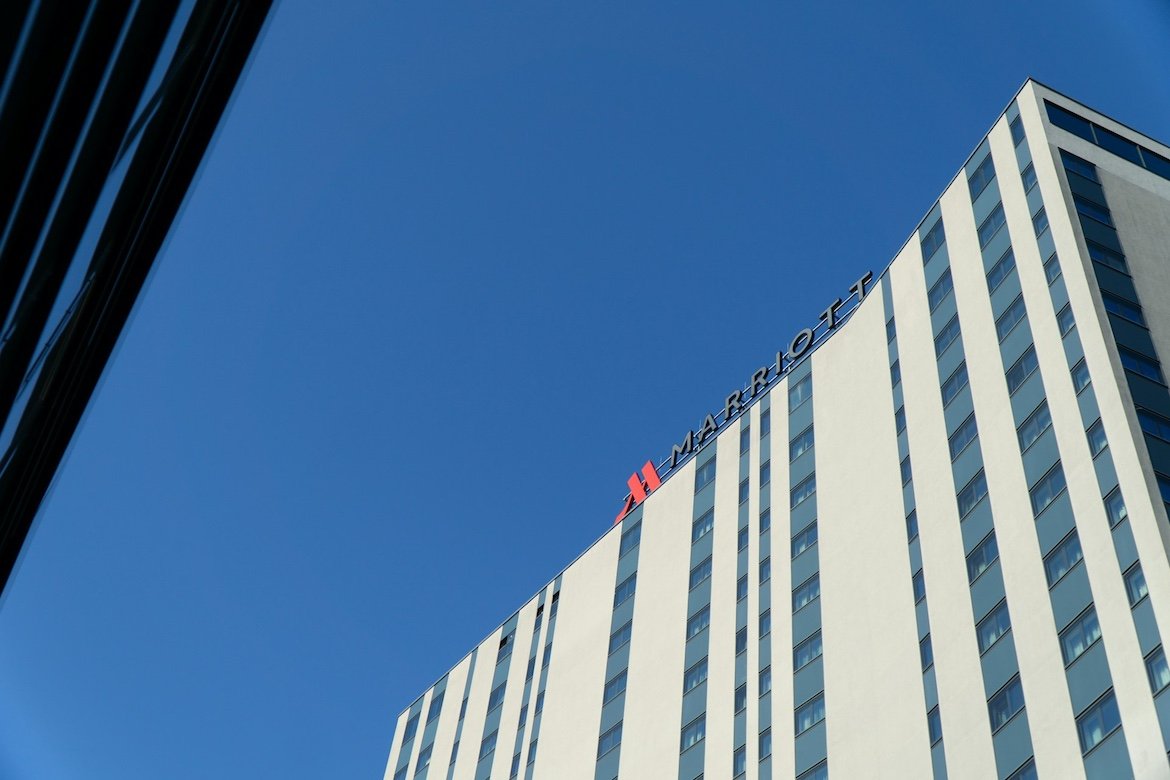

Marriott International closed the fourth quarter with mixed results, as a sharp drop in U.S. government travel offset gains from leisure and group segments.
Revenue per available room in the U.S. and Canada was essentially flat, reflecting a significant decline in business transient demand tied to a 43-day federal government shutdown. While executives had expected steadier growth, policy-driven disruptions proved to be a meaningful headwind for midscale and select-service properties in particular.
During the earnings call, Marriott’s leadership acknowledged that government-related bookings fell by more than 30% at the height of the shutdown. Although that decline has since moderated to around 15% for the year, the immediate ixmpact was concentrated in hotels that rely heavily on federal employees and contractors. Markets with strong government presence saw occupancy levels dip as travel authorizations were paused and business trips delayed.
Government Travel Declines Weigh on North America
Despite the setback, other segments posted modest gains. Leisure RevPAR increased 2% in North America during the quarter, while group RevPAR rose 1%. Those gains were not enough to fully counterbalance a 3% decline in business transient demand, which remains more sensitive to economic and political uncertainty.
The divergence was particularly visible across chain scales. Luxury properties continued to outperform, with annual RevPAR in that segment rising 6%. In contrast, select-service hotels saw a slight decline for the year. Executives pointed to continued resilience among higher-end consumers, who are prioritizing spending on experiences and travel over material goods. Roughly 10% of Marriott’s global room portfolio sits in the luxury category, a segment the company believes remains structurally strong.
Globally, performance painted a somewhat brighter picture. Fourth-quarter RevPAR rose 1.9%, driven largely by 6.1% growth in international markets. Europe and other overseas regions benefited from stronger leisure flows and recovering travel patterns, helping offset softness in North America.
Luxury Strength and 2026 Outlook
Looking ahead, Marriott forecasts global RevPAR growth of 1.5% to 2.5% in 2026. Executives expect the gap between the high end and the more price-sensitive segments to continue, though perhaps not as sharply as in 2025. The company’s broader strategy increasingly emphasizes premium brands and experiential travel, reflecting shifting consumer behavior in the post-pandemic landscape.
Financially, the company reported adjusted EBITDA of $1.40 billion for the quarter, up from $1.29 billion a year earlier. Quarterly revenue reached $6.69 billion, compared with $6.43 billion in the same period last year. While growth remains moderate, leadership expressed confidence that underlying demand for travel, particularly at the upper end of the market, provides a stable foundation.
Marriott also provided updates on its early-stage artificial intelligence initiatives, including collaborations with Google and OpenAI. The company plans to introduce natural-language search features across its digital platforms, though executives cautioned that AI applications remain in their infancy.
For now, Marriott’s fourth-quarter results underscore a broader theme in hospitality: government and corporate travel can fluctuate quickly, but leisure and luxury demand continue to offer resilience. As 2026 unfolds, the company’s performance may depend less on policy stability and more on its ability to capture higher-end, experience-driven travelers.