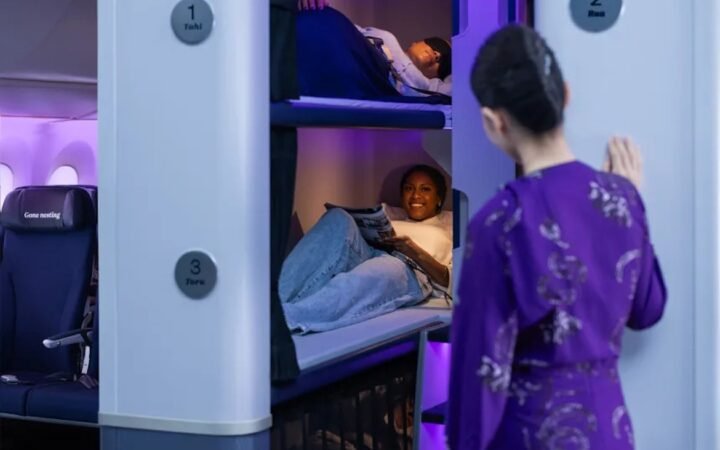

Air New Zealand is moving ahead with one of the most closely watched cabin innovations in long-haul aviation, confirming that its Economy Skynest will go on sale from May 18, 2026, ahead of a service launch in November. The product will be installed on the airline’s new Boeing 787-9 Dreamliners and gives economy and premium economy passengers the option to add a four-hour lie-flat sleep session to their journey.
For an airline based in one of the world’s most remote developed travel markets, the logic is easy to understand. New Zealand depends heavily on long-haul flying, and some of its nonstop routes rank among the longest commercial flights in the world. That makes comfort not just a premium issue, but a broader commercial one. If the journey becomes more manageable, more travelers may be willing to make it.
The Skynest is made up of six lie-flat pods arranged in a bunk-style layout between the economy and premium economy cabins. Each pod includes a full-length mattress, fresh bedding, a privacy curtain, ambient lighting, ventilation, reading light, charging ports, and a small amenity kit. Air New Zealand says the product was developed over several years and tested with more than 200 customers, reflecting how seriously the carrier views sleep as a core part of the ultra-long-haul experience.
The initial operating model is also carefully structured. Customers will be able to book a four-hour session, priced from NZD 495, with two sessions available per flight at launch. The airline says that timing was designed around natural sleep cycles, giving passengers enough time to settle in, rest properly, and wake up gradually rather than treating the pod as a quick novelty break.
That pricing means the Skynest will not be a casual add-on for everyone, but it also does not try to compete directly with business class. Instead, it creates a middle ground between sitting upright for 15 to 18 hours and paying a much higher premium for a front-cabin bed. In that sense, the real importance of the Skynest is strategic. It introduces a new kind of ancillary comfort product, one that could reshape how airlines think about monetizing rest in economy.
Air New Zealand has a history of testing new cabin ideas, including the Skycouch, and the Skynest fits that same pattern of practical innovation. The airline is not redesigning economy entirely, but it is acknowledging that on extreme long-haul flights, passengers may value the ability to lie flat for a few hours almost as much as they value the seat itself.
If the rollout goes well, the Skynest could become one of the most influential cabin experiments of the decade. For now, it gives Air New Zealand something rare in aviation: a genuinely new answer to a problem every long-haul traveler already understands.