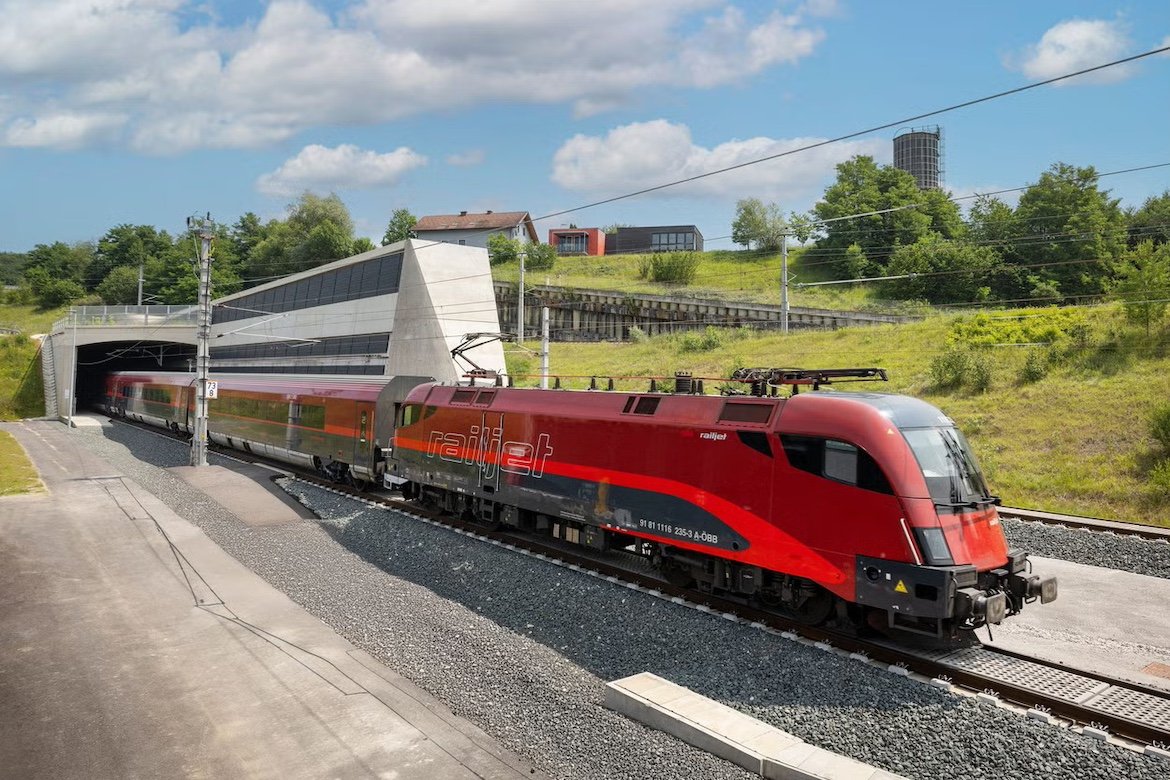
European rail travel reached an important milestone in December 2025 with the launch of a new high-speed Railjet connection linking Vienna and Trieste in under seven hours.
Operated by Austria’s national rail company, the service significantly reduces travel time between the Austrian capital and Italy’s northeastern port city, cutting the journey from more than nine hours to just six hours and 38 minutes.
The new timetable marks a decisive shift in how passengers can move between Central Europe and the Adriatic coast, offering a faster, more comfortable alternative to flying or driving.
The route departs daily from Vienna Central Station in the early morning and travels through Graz, Klagenfurt, Villach, Udine, and Grado before arriving in Trieste early in the afternoon.
This improved connection is made possible by the opening of the Koralm Railway, a 130-kilometer rail line that includes the Koralm Tunnel, one of the most ambitious rail infrastructure projects ever completed in Austria.
By bypassing slow and winding mountain routes, trains can now move efficiently through the Koralpe mountains, dramatically improving regional and international connectivity.
Beyond linking Vienna and Trieste, the new service also improves access to other destinations in northern Italy. Travelers heading to Venice, for example, can now reach the city about 30 minutes faster than before, bringing the total journey time to roughly seven hours.
For both tourists and business travelers, the upgrade makes rail a far more attractive option for cross-border trips.
Expanding Networks and Supporting Sustainable Mobility
The Vienna–Trieste Railjet is part of a wider expansion of Austria’s long-distance rail network introduced with the December 2025 timetable change. One of the most notable improvements is the introduction of half-hourly service between Vienna and Graz, increasing daily connections from 18 to 33.
Travel between Graz and Klagenfurt has also been transformed, with 29 daily train journeys replacing what was previously a limited bus-based connection. Similarly, daily rail services between Vienna and Klagenfurt have risen sharply, giving passengers far greater flexibility.
These changes reflect a broader strategy to position rail as the backbone of Austria’s transport system. By increasing frequency, reducing travel times, and improving comfort, the country aims to encourage travelers to shift away from cars and short-haul flights. Rail travel produces significantly lower carbon emissions, and investments like the Koralm Railway align closely with European Union climate targets and long-term sustainability goals.
The new high-speed link also has economic and social implications. Trieste stands to benefit from increased tourism and business travel, while cities along the route gain stronger connections to major European hubs. Smaller communities, once poorly served by long-distance transport, are now better integrated into the regional economy.
For passengers, the impact is immediate and practical. Day trips that were once unrealistic become feasible, and longer journeys feel less exhausting. Comfortable onboard services and scenic landscapes turn travel time into part of the experience rather than a burden.
The Vienna–Trieste Railjet is more than a timetable change. It represents years of planning, engineering, and investment aimed at reshaping how people move across borders in Europe. As high-speed rail continues to expand, this new connection stands as a clear signal of a future where travel is faster, greener, and more connected.