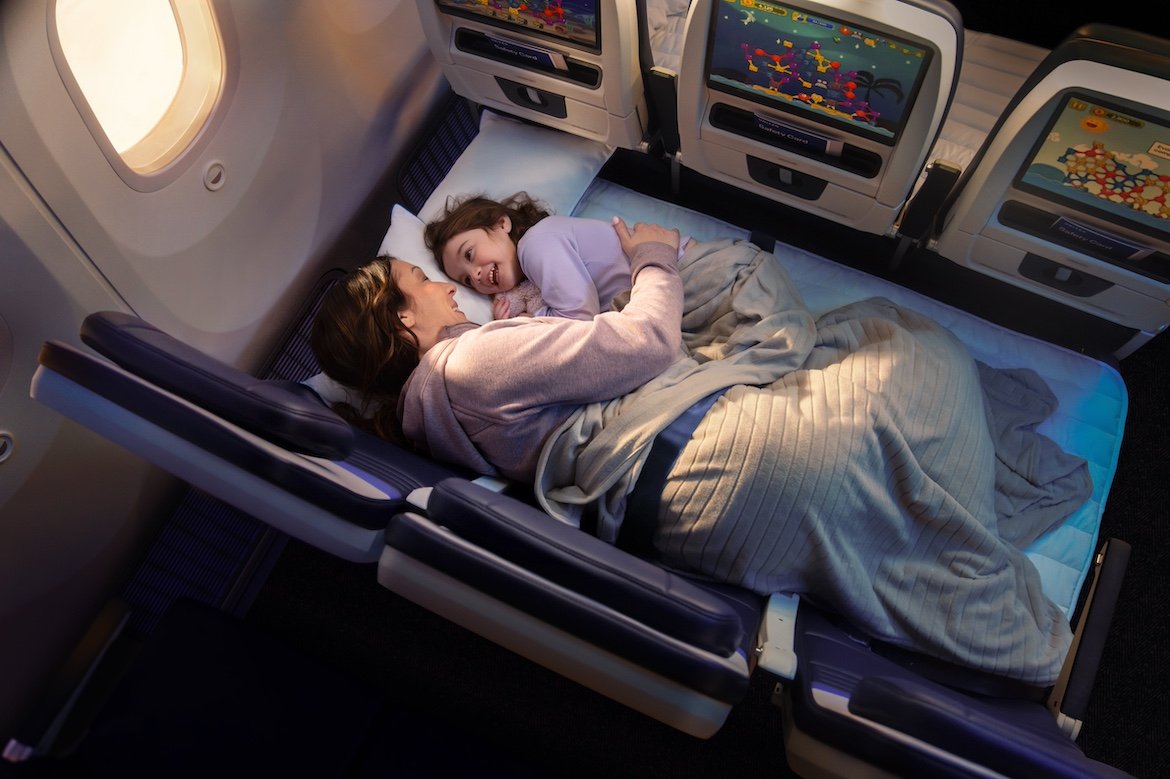
United Airlines is introducing a new long-haul seating concept aimed at narrowing the comfort gap between standard economy and premium cabins. Known as Relax Row, the product transforms a row of three economy seats into a couch-like surface, offering passengers more space to stretch out on international flights without paying for premium economy or business class.
The new product is scheduled to launch in 2027 and will be rolled out across more than 200 Boeing 787 and 777 widebody aircraft by 2030. United says the seat design will be positioned between United Economy and United Premium Plus, creating a new intermediate comfort option within the long-haul cabin layout.
Relax Row is designed as a dedicated three-seat section with adjustable leg rests that fold up to create a padded flat surface. Once raised, the seats function less like separate chairs and more like a lounge-style couch. The concept is particularly aimed at families with young children, couples, and solo travelers willing to pay for additional space while remaining in the main cabin.
A New Middle Ground in Long-Haul Travel
The innovation reflects a broader trend in airline strategy, where carriers are looking for new ways to monetize cabin space while improving the passenger experience. For years, long-haul economy has remained one of the least comfortable parts of air travel, especially on overnight routes where sleep is essential but difficult. Relax Row appears designed to address that pain point with a more flexible layout that still fits within the economics of a standard cabin.
Passengers booking the new product will also receive added amenities intended to reinforce the more restful experience. These include a custom-fitted mattress pad, specially sized blankets, extra pillows, and children’s items such as a plush toy and travel kit for families. The product is being presented not simply as extra legroom, but as a more sleep-friendly, lounge-style option for longer journeys.
United says it is the first airline in North America to offer this type of product and holds regional exclusivity on the design. While similar concepts exist internationally, the move gives the carrier a distinctive feature in a competitive long-haul market where airlines are increasingly differentiating through cabin innovation rather than only fares or routes.
Part of a Broader Cabin Strategy
Relax Row is also part of United’s larger push to modernize its long-haul fleet and improve the experience across every cabin. The airline has been investing heavily in premium-heavy aircraft layouts, upgraded seatback screens, better power access, and enhanced onboard technology. In that context, Relax Row fits into a strategy that acknowledges economy passengers still want more comfort and are willing to pay selectively for it.
The product may also help United appeal to travelers who do not see premium cabins as financially realistic but still want a better experience on ultra-long-haul routes. By creating a softer, more flexible product between economy and premium economy, the airline is expanding its range of upsell opportunities while making the main cabin more attractive.
Pricing details have not yet been disclosed, but industry observers expect Relax Row to function as an add-on that likely requires reserving all three seats in a row. That would make it comparable to other couch-style products in the global market, where the appeal lies in buying space rather than moving into an entirely different cabin class.
For United, the significance of Relax Row goes beyond comfort alone. It shows how airlines are increasingly redesigning cabins around passenger behavior, recognizing that rest, privacy, and flexibility are becoming just as important as traditional service elements in shaping loyalty on long-haul flights.