

A tourism concept designed to recreate the Moon on Earth is edging closer to reality. Moon World Resorts has unveiled plans for a series of large-scale lunar-themed destinations across up to 10 countries, positioning the project as a new category of global tourism infrastructure rather than a standalone attraction.
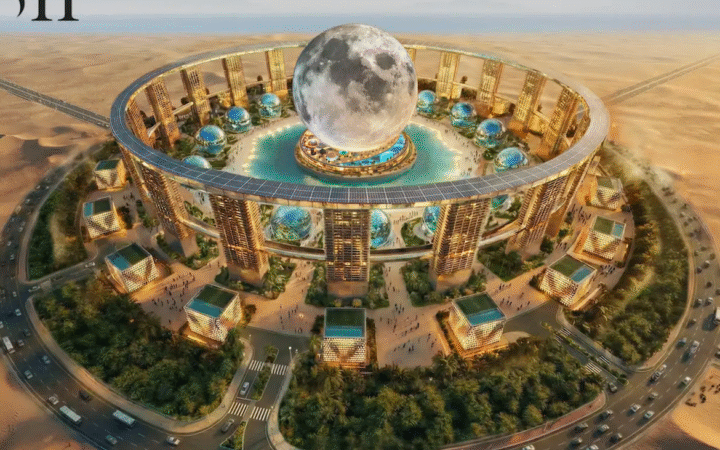
The proposed development centers on what would become the world’s largest true spherical structure, rising more than 300 meters high. Inside, developers plan to simulate the surface and environment of the Moon, combining immersive entertainment with hospitality, education and residential real estate. Each resort is designed to welcome approximately 10 million visitors annually, with the lunar experience alone expected to attract about 2.5 million guests per year.
According to company executives, interest has accelerated significantly in recent months. The concept is structured as a licensing and design model, with regional partners independently owning each location while Moon World Resorts provides intellectual property and master planning expertise.
Ten countries have been identified as potential hosts: the UAE, China, Thailand, Brazil, Poland, Spain, India, Australia, Egypt and the United States. Developers suggest that markets such as the UAE and China could advance more quickly due to streamlined regulatory processes and strong investment ecosystems. While no final locations have been announced, 2026 is expected to be a decisive year for formal confirmations.
A $5 Billion Integrated Tourism Platform
Each Moon destination is estimated to cost approximately $5 billion for the core resort component, excluding land acquisition. The masterplan spans roughly 500 acres and integrates a 4,000-room luxury hotel within the central sphere, supported by convention centers, wellness hubs, entertainment venues, retail districts and educational facilities.
The financing model relies primarily on private capital. Residential sales will play a significant role, using an off-plan structure similar to other large-scale real estate projects in the Middle East and Asia. Developers argue that once government approvals and land allocations are secured, funding will follow, given investor appetite for large fixed-asset projects tied to global tourism.
Government backing remains the critical first step. Clear regulatory support and fast-tracked approvals are considered prerequisites before construction can begin.
Real Estate as the Long-Term Engine
Beyond tourism, the residential component is central to the project’s financial sustainability. Plans call for approximately 10,000 luxury residential units integrated into the broader development, including towers and sphere-shaped structures connected by panoramic skywalks and landscaped public spaces.
The aim is to create a year-round live-work-play environment rather than a seasonal attraction. By combining hospitality, entertainment and permanent residences, the project seeks to balance visitor demand with ongoing community activity.
If timelines hold, the first Moon development could open around 2032. While still in the planning phase, the scale and ambition of the concept position it among the most audacious tourism initiatives currently under discussion.
If realized, Moon World Resorts would blur the boundaries between destination resort, urban development and experiential entertainment, effectively attempting to bring space tourism to ground level.