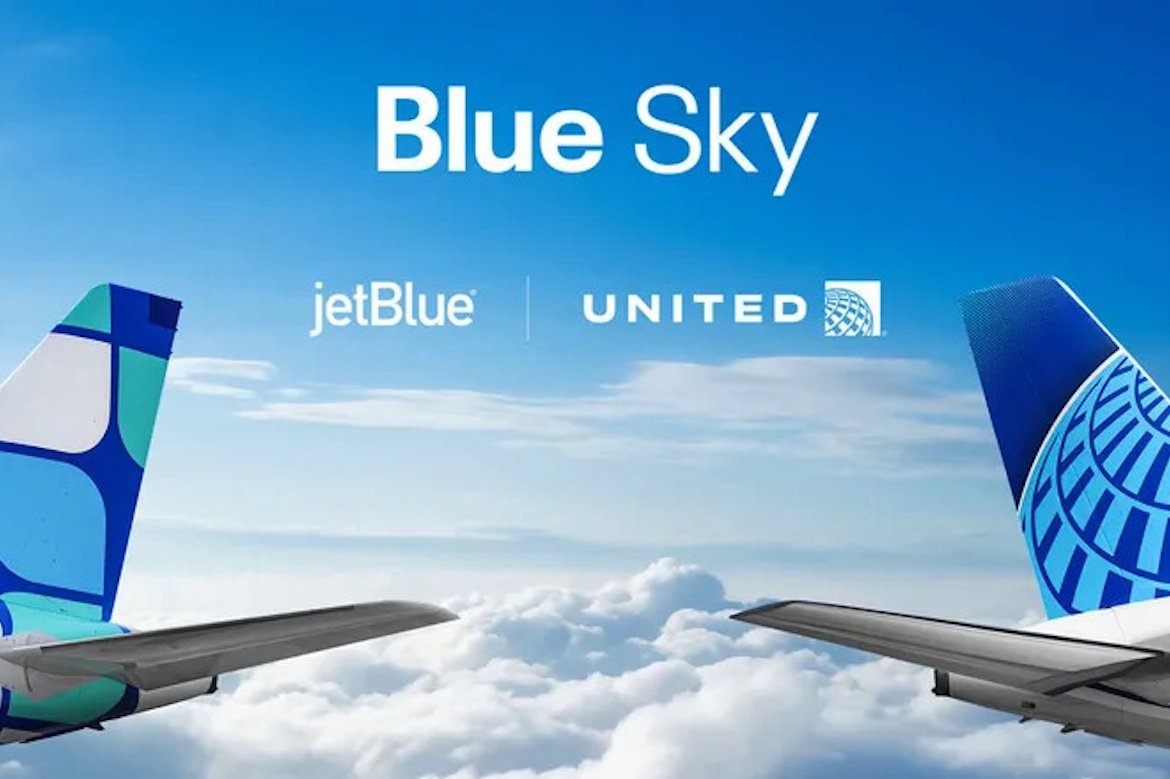
JetBlue and United are deepening their commercial partnership, marking a new phase in the so-called Blue Sky collaboration that significantly expands booking flexibility for customers on both networks.
Beginning this week, travelers can purchase eligible itineraries operated by either airline directly through JetBlue or United’s websites and mobile apps, using cash, JetBlue TrueBlue points, or United MileagePlus miles.
The move builds on the first phase of the partnership introduced in 2025, which allowed reciprocal loyalty earning and redemption. Now, revenue bookings across both carriers represent a tangible shift in how the two airlines position their networks – less as competitors in certain markets and more as complementary platforms offering broader reach and more payment options.
Broader Booking Access Across Two Networks
For customers, the most immediate change is visibility. When searching for flights on either airline’s digital channels, users will now see a wider range of options that include eligible services operated by the partner carrier.
A JetBlue customer browsing JetBlue.com, for example, may see United-operated routes that extend beyond JetBlue’s core leisure footprint. Likewise, United customers gain streamlined access to JetBlue’s strong presence across the Caribbean, Latin America, and select European routes.
Importantly, travelers can book using their preferred currency. TrueBlue members can redeem points for eligible United-operated itineraries through JetBlue’s channels, while MileagePlus members can use miles for eligible JetBlue flights when booking through United. This flexibility addresses one of the most persistent friction points in airline partnerships: loyalty silos that limit redemption value.
For now, bookings must still be made separately within each airline’s ecosystem, meaning customers cannot yet create a single itinerary that combines flights operated by both carriers. However, both airlines have confirmed that interline capabilities – allowing seamless multi-carrier itineraries – are planned for a future phase.
JetBlue Vacations is also expanding under the collaboration. United flights are now available within JetBlue’s Flight + Hotel packages, broadening long-haul and international options for leisure travelers. Cruise packages supported by United inventory are expected to follow, signaling a wider push into bundled travel products.
Loyalty Perks, JFK Growth, and What Comes Next
The next milestone in the Blue Sky rollout is scheduled for spring, when reciprocal elite perks will be introduced. Status members in TrueBlue and MileagePlus are expected to receive benefits such as priority boarding, preferred and extra-legroom seating, and same-day changes or standby across both airlines. These features move the partnership closer to a quasi-alliance model, even though the carriers remain independent.
A longer-term structural element of the collaboration involves New York’s JFK Airport. Beginning in 2027, JetBlue plans to lease up to seven daily roundtrip slots to United at JFK’s new Terminal 6. This arrangement would enable United to reestablish a meaningful presence at JFK, complementing its dominant position at Newark Liberty International Airport and strengthening its competitive stance in the New York market.
Additionally, United’s MileagePlus travel platform is expected to transition to Paisly later in 2026, expanding ancillary booking capabilities such as hotels, vacation packages, rental cars, cruises, and travel insurance. This mirrors JetBlue’s broader strategy of building an integrated digital travel ecosystem rather than focusing solely on air tickets.
Taken together, the second phase of Blue Sky represents more than a codeshare-style arrangement. It reflects a strategic recalibration by both airlines to increase distribution reach, improve loyalty stickiness, and compete more effectively against larger global alliances.
For travelers, the immediate impact is greater choice and payment flexibility. For the industry, it signals a new model of bilateral collaboration that blends revenue sharing, loyalty integration, and network expansion without a formal merger.