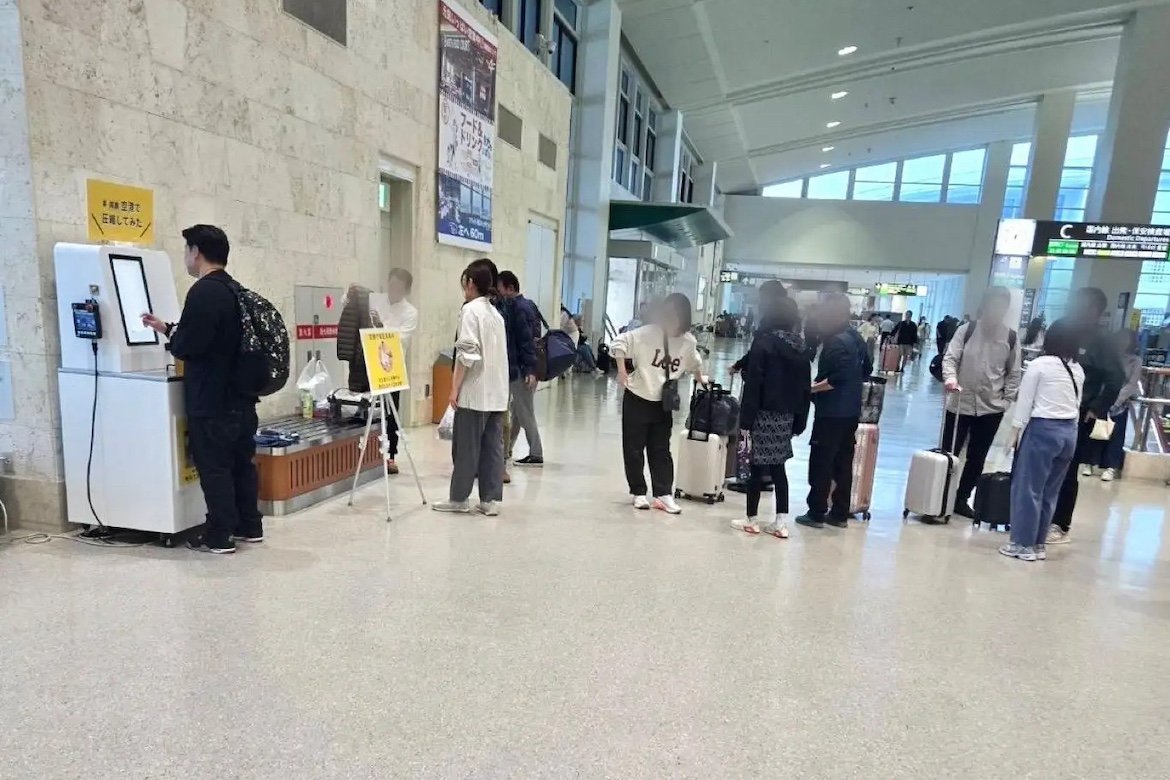
Travelers passing through Haneda Airport in Japan this January may notice an unusual new service designed to solve a familiar problem. For four days in mid-January 2026, an automatic clothing compression machine will be tested in Terminal 3, allowing passengers to compress worn clothes and small items into palm-sized bundles before departure. The trial reflects growing interest in airport-based services that reduce travel stress and improve the overall passenger experience.
The demonstration is being led by SJOY Co., Ltd., which has developed a system that automatically compresses clothing in about one minute. Travelers simply place their clothes inside the machine, with no special packing skills required. Depending on the garment, items can be reduced to as little as one-seventh of their original size, freeing up valuable suitcase space at a moment when many travelers are struggling to fit souvenirs or last-minute purchases.
The test is open to all passengers and requires no reservation or fee, making it easy to try while reorganizing luggage near the check-in area. The timing and location are deliberate. Packing and repacking at the airport is a common source of frustration, especially for international travelers navigating weight limits, security procedures, and crowded terminals. By offering compression on the spot, the service aims to streamline that process and reduce the need for hurried rearranging at boarding gates.
Previous trials suggest strong interest from travelers. Earlier demonstrations at other Japanese airports attracted hundreds of participants, with most users reporting noticeable space savings and a desire to use the service again. Many travelers also compressed their clothing more than once during a single visit, suggesting practical value rather than novelty appeal. Feedback from these tests has already led to improvements such as faster compression times and multilingual touch-screen controls.
Beyond individual convenience, the trial also addresses broader airport challenges. Bulky luggage and discarded suitcases have become an issue at busy hubs, particularly as inbound tourism continues to rise. Compressing clothes at the airport can reduce the temptation to abandon older bags or clothing, contributing to cleaner terminals and more efficient waste management.
The experiment forms part of a wider initiative to turn airports into testing grounds for new travel technologies. If successful, automatic clothing compression could become a standard amenity, not only at airports but also at nearby hotels and public facilities. For travelers, it represents a small but potentially meaningful shift toward smarter, less stressful journeys, where even packing becomes part of a more seamless travel experience.